

Google is making a bigger bet on AI-powered personal computing.
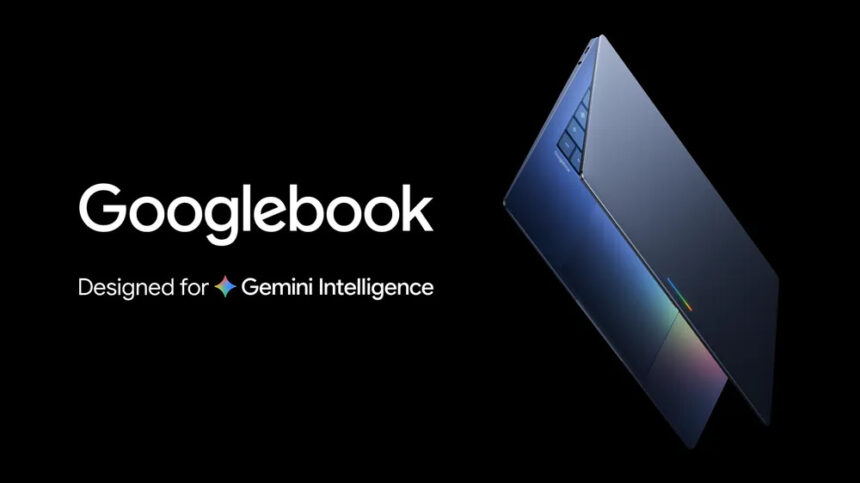
After introducing the Googlebook earlier this year, the company has opened preorders for its new AI-focused laptop line, starting at $899.
Googlebook is positioned as a step beyond the traditional Chromebook. Instead of ChromeOS, the new machines run Android OS with a desktop version of Chrome, while retaining some familiar elements of the Chromebook experience.
But the operating system isn’t the main attraction.
- Advertisement -
Google wants Gemini to become a fundamental part of how people interact with their laptops, embedding AI directly into everyday actions such as pointing, selecting, writing, searching, and creating.
Meet the AI-Powered Magic Cursor
One of Googlebook’s most distinctive features is the Magic Cursor, which effectively turns the traditional mouse pointer into an interface for Gemini.
Users could highlight information on a webpage and immediately ask Gemini to work with it.
Hover over a suspicious email, for example, and Gemini could help analyze whether it appears legitimate. Select multiple images, and the AI could help visualize how they might look together.
The idea resembles Google’s Circle to Search experience on Android, but adapted for desktop computing.
- Advertisement -
Rather than opening an AI application every time assistance is needed, Google wants Gemini available directly through the way people already interact with content.
Rambler Turns Messy Thoughts Into Clean Writing
Another potentially useful feature is Rambler, Google’s AI-enhanced dictation system.
Instead of simply transcribing everything a user says word for word, Rambler can take an unstructured voice dump and transform it into cleaner, more readable text.
- Advertisement -
That could be useful when drafting emails, taking notes, capturing ideas, or creating documents without carefully organizing every sentence beforehand.
Googlebook also includes vibe-coded widgets, alongside access to other Gemini capabilities such as Gemini Spark and Gemini Live.
However, several of these AI experiences don’t inherently require specialized laptop hardware, raising an important question: will consumers buy a new computer specifically to access deeper Gemini integration?
Googlebook Could Signal the Future of Chromebooks
The bigger story may be Google’s long-term computing strategy.
Chromebooks already have a substantial presence in education. Google has previously said that roughly 50 million Chromebooks are used by students and educators in schools.
That gives the company an enormous existing user base that could eventually transition toward a more AI-native computing environment.
Google has said current Chromebooks will continue receiving support, while many machines may eventually become eligible to transition to the new Googlebook experience.
If that strategy succeeds, Gemini could become deeply embedded in how millions of students and educators interact with computers.
Premium Hardware Meets AI
Google isn’t positioning Googlebook as inexpensive classroom hardware alone.
Flagship machines are being developed by Acer, ASUS, Dell, HP, and Lenovo, using materials including aluminum, magnesium alloy, and carbon fiber.
Depending on the configuration, devices can feature up to 2.8K OLED displays, haptic glass trackpads, backlit keyboards, and processors from Intel and Qualcomm with dedicated NPUs.
Google claims up to 14 hours of battery life and says devices will receive regular updates for as long as 10 years.
The $899 package also includes 12 months of Google AI Pro, providing 5TB of cloud storage and access to Gemini Advanced tools, alongside temporary subscriptions to services including YouTube Premium and Adobe Photoshop.
Can Gemini Sell a Laptop?
Googlebook is ultimately testing an important question facing the entire PC industry.
Consumers can already access powerful AI tools through browsers and applications on computers they own today.
Google therefore needs to demonstrate why having AI integrated throughout the operating experience is meaningfully better than simply opening Gemini in another tab.
Googlebook will reach U.S. stores on October 4, followed by Canada, the U.K., Ireland, France, Germany, and Australia on October 5.
Its success could reveal whether consumers genuinely want an AI-native computer — or whether the laptop they already own is good enough for the AI era.
Google isn’t simply selling another laptop. It’s betting that Gemini can become important enough to influence which computer people buy next.