


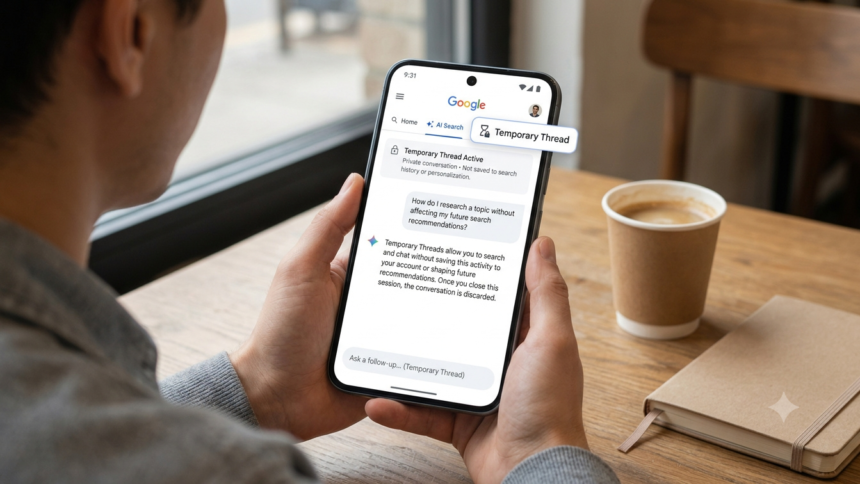
Google is taking another step toward giving users more control over their online privacy by introducing a temporary conversation feature in its AI-powered Search experience. The new functionality allows users to explore topics through Google AI Mode without having those discussions influence their future search recommendations or personalization.
The update addresses a growing concern among people who regularly use AI-powered search tools: how to enjoy conversational assistance without keeping every interaction connected to their personal search activity.
A More Private Way to Explore AI Search
Google’s AI Mode transforms traditional searching into an interactive experience. Instead of simply displaying a list of websites, it allows users to ask questions, explore related subjects, and receive conversational responses.
However, not every search conversation is something users want associated with their regular browsing activity.
- Advertisement -
To address this, Google has introduced a feature called Temporary Threads. It gives users the option to start a separate AI conversation that is not intended to appear later in their search history or influence personalized recommendations.
This makes AI Mode more flexible for people who want to research personal subjects, investigate unfamiliar topics, or ask occasional questions without changing their usual search experience.
How Google’s Temporary Threads Work
Using the new feature is designed to be straightforward. Users do not need to navigate through complicated privacy settings or change their account preferences.
Instead, they can select the Temporary Threads icon located in the upper-right corner of the AI Mode interface. Once activated, a separate conversation begins.
According to Google, these temporary sessions operate independently of the user’s regular account-based search experience.
- Advertisement -
There are two important aspects to this functionality:
- Reduced personalization: Responses within temporary conversations will not rely on the user’s previous search preferences in the usual way.
- No future personalization impact: The subjects discussed in these sessions will not be used to shape future personalized recommendations.
After users close the temporary conversation, they can return to their regular Google Search experience.
Why This Update Matters for AI Users
Privacy is becoming an increasingly important consideration as AI assistants become part of everyday digital activities.
- Advertisement -
People now use AI tools for everything from professional research and learning to personal questions and sensitive information searches. While personalized responses can make these tools more useful, some users may not want every conversation to influence their digital profiles.
Temporary Threads offer a practical middle ground. Users can benefit from conversational AI while keeping certain discussions separate from their ongoing search activity.
The feature may also be helpful for people researching subjects outside their normal interests. For example, someone exploring a topic for a one-time project may prefer that it does not affect the recommendations they receive in the future.
AI Platforms Are Making Temporary Conversations Standard
Google’s introduction of Temporary Threads reflects a broader direction across the AI industry.
Several conversational AI platforms already provide temporary or private chat options. Google’s Gemini assistant also offers temporary conversations.
Bringing similar functionality directly into AI Mode makes sense because users increasingly expect search engines to provide the convenience of AI chatbots.
Rather than requiring people to switch between different applications, Google is extending privacy-focused functionality within the search experience itself.
Global Availability and What’s Next
Google has announced that Temporary Threads are rolling out globally across desktop and mobile devices in all supported languages.
The introduction highlights how AI search is evolving beyond delivering quick answers. Users increasingly expect these platforms to offer greater flexibility, personalization controls, and privacy-conscious experiences.
As conversational search becomes more common, features that allow users to manage how their interactions are used could become an important part of building trust in AI-powered technology.
The Bigger Picture: The future of AI search will not depend only on how intelligently platforms answer questions. Giving users greater control over their conversations, preferences, and privacy will also play an important role in shaping the next generation of search experiences.