


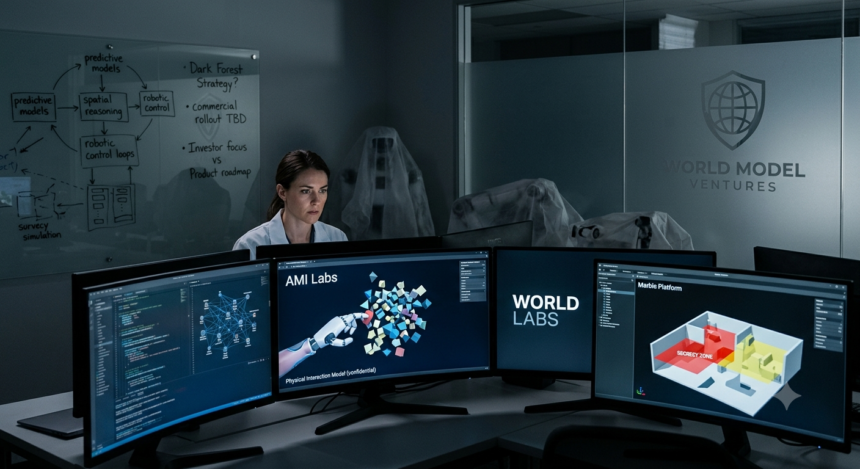
The race to build AI systems that can understand and simulate the physical world is gaining momentum, but some of the companies leading that race are revealing surprisingly little about what they plan to commercialize.
World models are emerging as a major area of artificial intelligence research. Unlike traditional language models that primarily work with text, world models aim to understand environments, spatial relationships, movement, and how real-world situations change over time. That could eventually make them useful across robotics, autonomous vehicles, manufacturing, healthcare, gaming, video creation, and other applications.
According to TechCrunch, companies including AMI Labs, founded by Yann LeCun, and World Labs, founded by Fei-Fei Li, have attracted substantial attention and funding while remaining relatively cautious about revealing detailed product strategies.
Why World Models Are Different
The concept behind world models is broader than simply generating images or answering questions. The goal is to develop AI systems that can build an internal representation of how the world works and use that understanding to predict what could happen next.
- Advertisement -
For example, an AI system operating a robot may need to understand that moving an object could change the position of other objects, or that a particular physical action could create an unexpected result.
This type of spatial and physical reasoning could become particularly important as AI moves beyond screens and into physical environments.
That makes world models relevant to industries where software has to interact with the real world rather than simply produce digital content.
AMI Labs Is Still Keeping Its Plans Private
AMI Labs, the world-model company associated with Yann LeCun, is one of the most closely watched startups in this emerging category.
The company has attracted major investment and has described ambitions around building AI systems that understand the real world. However, its leadership has not publicly provided a detailed roadmap for upcoming commercial products.
- Advertisement -
TechCrunch reported that Michael Rabbat, a co-founder and VP of World Models at AMI Labs, declined to provide specific details about what the company is developing or when products could arrive. The company explained that it remains in a research and building phase and is not currently discussing product plans or timelines publicly.
That approach is understandable for a young research-driven company, but it also highlights how early the commercial world-model market remains.
AMI Labs previously raised $1.03 billion at a $3.5 billion pre-money valuation, demonstrating the scale of investor interest surrounding the technology even before the company has a conventional commercial product portfolio.
- Advertisement -
World Labs Is Showing More of What Is Possible
World Labs has provided somewhat more visibility into its technology through Marble, a platform capable of generating explorable 3D environments.
The technology demonstrates potential applications ranging from media production and gaming environments to CGI and other forms of digital content creation. Robotics is another possible direction for world-model technology, although the broader commercial strategy of these companies remains difficult to predict.
This illustrates one of the biggest characteristics of world models: the same underlying technology could potentially support several industries.
A system capable of understanding physical environments could potentially help generate interactive virtual worlds today and contribute to robotic systems tomorrow.
The Technology Has Many Possible Markets
World models are not limited to one specific business category.
Potential applications include:
Robotics: AI-powered robots could use spatial understanding to navigate unpredictable environments and interact with objects.
Autonomous vehicles: World models could help vehicles simulate and anticipate changes in their surroundings.
Gaming: Developers could potentially create interactive environments that respond dynamically to users.
Media and entertainment: AI-generated 3D environments could support filmmaking, visual effects, and virtual production.
Manufacturing: Industrial systems could potentially use simulations to improve automation and operational planning.
Healthcare: AI systems could eventually combine real-world understanding with domain-specific information for certain healthcare applications.
AMI Labs has already indicated interest across areas including manufacturing, biomedicine, robotics and healthcare through its partnership with Nabla.
Why Companies May Be Choosing Secrecy
There is a strategic reason for keeping world-model development quiet.
The technology is attracting significant amounts of capital, but its most valuable commercial applications have not yet been firmly established. If a company publicly identifies a promising use case too early, competitors could potentially redirect their own resources toward the same opportunity.
This creates an unusual situation.
Companies have enough funding to continue researching and developing their systems without immediately needing to reveal a commercial product. At the same time, revealing too much could give competing AI labs, startups, and technology companies valuable information about where the market may be heading.
TechCrunch described this competitive environment as resembling a “Dark Forest” scenario, where companies have incentives to remain quiet until they are ready to reveal what they have built.
The Funding Race Is Already Underway
The secrecy surrounding product plans does not mean investors are ignoring the sector.
The opposite appears to be happening.
World-model startups have attracted significant investment throughout 2026. Odyssey, another company working on world models, raised $310 million in a Series B round at a $1.45 billion valuation in June, with investors including Amazon, AMD Ventures and GV. Its technology is aimed at applications including gaming and robotics.
General Intuition has also been developing world models designed to help AI agents understand space and time, using large amounts of interactive gaming data as training material.
These developments suggest that world models are becoming a broader AI category rather than a research project limited to a handful of laboratories.
From Generative AI to Physical Intelligence
The emergence of world models could represent another stage in the evolution of AI.
Generative AI has largely focused on creating and processing digital information such as text, images, audio and video. World models are aimed at a different challenge: understanding environments and predicting how they behave.
That distinction becomes increasingly important as companies attempt to build AI-powered machines that operate outside traditional software environments.
A chatbot can generate instructions for moving an object. A robot needs to understand where that object is, how much force is required to move it, what is around it, and what could happen after the movement.
This is why spatial intelligence and physical reasoning are becoming increasingly important areas of AI research.
What Businesses Should Watch
For businesses, the immediate impact of world models may not be a sudden replacement of existing AI systems.
Instead, the technology could gradually expand the types of tasks AI can support.
Companies operating in manufacturing, logistics, robotics, automotive technology, gaming, media, healthcare and industrial automation should pay attention to developments in this space.
The important question is no longer only whether AI can generate information. It is whether AI can understand an environment well enough to make useful predictions and interact with it safely.
That transition could create new opportunities for software companies, data providers, hardware manufacturers, AI infrastructure providers and specialized technology vendors.
The Next Phase of the AI Race
The world-model market is still developing, and many commercial questions remain unanswered.
Which industries will adopt the technology first? How expensive will large-scale world-model training become? What data will companies need to build accurate simulations? And will startups be able to turn enormous research investments into sustainable businesses?
Those questions remain open.
For now, companies such as AMI Labs and World Labs appear to be prioritizing research, development and technological differentiation while keeping some of their commercial plans private.
What is becoming clearer is that the next generation of AI competition may extend beyond language and content generation toward spatial intelligence, simulation and physical-world understanding.
The companies building these systems may not be ready to reveal everything yet, but the investment surrounding them suggests that the technology is becoming an increasingly important part of the broader AI landscape.