


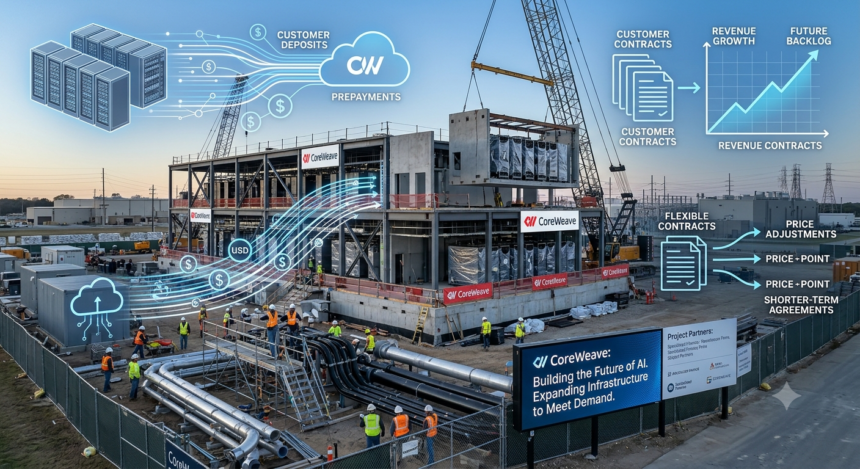
The AI infrastructure provider is turning to customer deposits, contract-backed financing, and shorter-term agreements to support its rapid expansion while managing growing debt obligations.
The rapid expansion of artificial intelligence is creating enormous opportunities for companies providing the computing infrastructure behind modern AI applications. However, meeting this growing demand requires significant capital, particularly for businesses investing heavily in data centers, GPUs, and advanced computing facilities.
CoreWeave, a major provider of cloud computing infrastructure for AI workloads, is taking a different approach to financing its expansion. Rather than depending primarily on traditional borrowing, the company is increasingly asking customers to make upfront payments, securing loans against customer contracts, and exploring shorter-term agreements that offer greater pricing flexibility.
The strategy reflects how AI infrastructure companies are adapting their financial models to keep up with increasing demand while controlling the cost of expansion.
- Advertisement -
Strong Revenue Growth Comes With Financial Pressure
CoreWeave reported approximately $3.66 billion in revenue during the third quarter of 2026, representing a 168% increase compared with the same period last year.
Despite this impressive growth, the company recorded a net loss of $709 million. Its quarterly interest expenses also reached approximately $846 million, highlighting the financial pressure associated with building and operating large-scale AI infrastructure.
With a reported customer backlog of $132.5 billion, CoreWeave has significant future business to deliver. However, fulfilling those commitments requires continued investment in computing capacity and supporting infrastructure.
The company is therefore looking for financing options that connect borrowing more directly to the contracts generating future revenue.
Customer Prepayments Become a Major Funding Source
One of CoreWeave’s most important financial strategies involves collecting money from customers before delivering computing services.
- Advertisement -
The company expects to receive approximately $9 billion in customer deposits and advance payments over the following three months. A portion of this amount is connected to new customer agreements for computing capacity that has already been developed.
This approach offers an important financial advantage. Instead of borrowing additional money to support every stage of expansion, CoreWeave can use customer payments to improve its cash position and reduce immediate financing requirements.
Other AI infrastructure providers, including Nebius and IREN, have also used substantial customer prepayments, particularly through agreements with Microsoft.
- Advertisement -
This suggests that advance payments could become an increasingly important funding model across the AI infrastructure industry.
However, receiving money upfront also creates long-term commitments. Companies must continue delivering services under agreed pricing terms, even if computing demand and market prices increase in the future.
Shorter Contracts Offer Greater Pricing Opportunities
Another important part of CoreWeave’s strategy is increasing its focus on shorter-term customer agreements.
Long-term contracts provide predictable revenue, but shorter agreements allow infrastructure providers to adjust pricing more frequently as market conditions change.
CoreWeave has already increased prices across its services, including an approximately 25% adjustment in July followed by another 10% increase later in the quarter.
The company is also directing more computing capacity toward short-term opportunities where higher prices can generate better returns.
According to management, certain short-term arrangements can generate more than $40 million per megawatt annually, compared with approximately $20 million to $25 million for new infrastructure commitments under four- and five-year contracts.
This pricing difference highlights why flexible contracts are becoming attractive as demand for AI computing continues to grow.
Contract-Backed Loans Reduce Dependence on Traditional Debt
CoreWeave is also changing how it approaches borrowing.
Instead of relying heavily on unsecured debt, the company is increasingly using financing arrangements supported by specific customer contracts.
In August 2026, it completed a $2.6 billion financing facility designed around shorter-term customer agreements. The structure allows funds to be borrowed in installments when required, helping the company manage infrastructure spending more efficiently.
However, lenders generally prefer longer-term agreements because they provide more predictable revenue and repayment schedules.
There are also concerns among bond investors about the amount of debt required to finance data center development before those investments generate sufficient returns.
What This Means for the Future of AI Infrastructure
CoreWeave’s evolving financing strategy demonstrates how rapidly the economics of AI infrastructure are changing.
Customer prepayments, flexible contracts, and contract-backed financing could help infrastructure providers expand without depending entirely on traditional debt markets.
Nevertheless, these approaches carry risks. Shorter agreements can create uncertainty around renewals, while upfront payments may limit future pricing flexibility. Continued investment also depends on sustained demand for AI computing.
As competition increases and infrastructure costs remain high, the ability to balance expansion, profitability, and financial stability will become increasingly important.
The bigger takeaway: The AI infrastructure race is no longer just about building more computing capacity. It is also about finding sustainable ways to finance that growth while ensuring that future demand can justify today’s investments.