


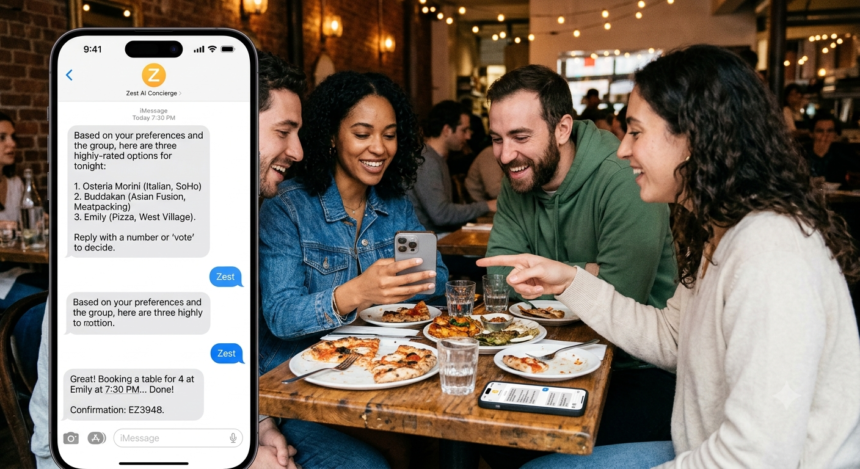
Restaurant discovery is moving beyond traditional mobile applications as artificial intelligence makes everyday decisions easier and faster. Zest, a restaurant discovery startup, is taking this approach further with a new AI-powered concierge that allows users to discover restaurants, explore dining options, and reserve tables directly through text messages.
The newly introduced service is designed to simplify the process of deciding where to eat. Instead of opening an application, searching through restaurant listings, comparing reviews, and visiting separate booking platforms, users can communicate with Zest through a regular text conversation. The AI assistant handles recommendations and reservation requests within the same interaction.
Turning Text Conversations Into Restaurant Reservations
Zest’s latest feature represents a growing trend in AI development, where intelligent assistants are becoming more capable of completing tasks rather than simply answering questions. The company believes that conversational interfaces could become an important way for consumers to interact with digital services.
The AI concierge can recommend restaurants based on cuisine preferences, specific cravings, dining occasions, dietary requirements, and preferred neighborhoods. Users can also ask questions about individual restaurants, including expected crowd levels, available facilities, Wi-Fi access, and menu options.
- Advertisement -
Beyond recommendations, the assistant can check restaurant availability and arrange reservations through established booking platforms such as OpenTable, Resy, and SevenRooms. This creates a more connected experience, allowing users to move from discovering a restaurant to securing a table without switching between multiple applications.
Personalized Suggestions Based on Real Dining Habits
One of Zest’s key differentiators is its approach to understanding customer preferences. Rather than depending entirely on users manually entering their interests, the platform uses dining-related transaction information to develop a better picture of their restaurant habits.
Through its integration with Plaid, a financial data connectivity provider, Zest can access relevant food and beverage transactions from connected financial accounts. The company uses this information to understand where users regularly spend money on dining and what types of restaurants they may prefer.
This information helps the platform deliver recommendations that are more closely aligned with actual customer behavior. It can suggest restaurants in a user’s hometown or provide relevant dining options when they travel to unfamiliar destinations.
The company says its focus remains on food and beverage transactions when creating personalized restaurant recommendations.
- Advertisement -
Group Chats Make Dining Decisions Easier
Another interesting capability is the concierge’s ability to participate in group text conversations. Choosing a restaurant with friends, family, or colleagues often involves comparing different preferences and spending time reaching a common decision.
Zest aims to reduce this friction by considering the preferences of multiple participants and recommending restaurants that suit the group. Its built-in voting feature also allows participants to select their preferred options directly within the conversation.
Once a decision is made, the AI assistant can proceed with checking availability and booking a table for the group. This makes the entire experience more convenient, particularly for people organizing dinners or social gatherings.
- Advertisement -
A New Revenue Opportunity Through AI-Powered Services
Zest was originally launched as a restaurant discovery platform and has secured $1.8 million in pre-seed funding from investors including Alexis Ohanian’s 776 and Steve Jang’s Kindred Ventures.
With its move toward conversational AI, the startup is also exploring new ways to generate revenue. Restaurant reservations and future food-ordering capabilities are expected to become important commercial opportunities. By participating in transactions completed through connected services, the company could establish revenue streams beyond its original discovery-focused offering.
The startup is also considering expanding its recommendation capabilities into other areas, including shopping and business discovery.
The Bigger Picture: AI Agents Are Becoming Everyday Assistants
Zest’s latest development highlights how AI agents are changing the relationship between consumers and digital platforms. Instead of requiring people to navigate different applications and complete every step manually, conversational assistants are increasingly capable of managing entire workflows.
For businesses, this shift creates opportunities to rethink customer engagement, service delivery, and digital experiences. Personalized recommendations, automated transactions, and conversational interactions could become important differentiators in an increasingly competitive digital environment.
As AI technology continues to advance, the value of an intelligent assistant may depend less on how many questions it can answer and more on how effectively it can complete real-world tasks. Zest is bringing that concept to restaurant discovery, turning a simple text conversation into a complete dining experience.