


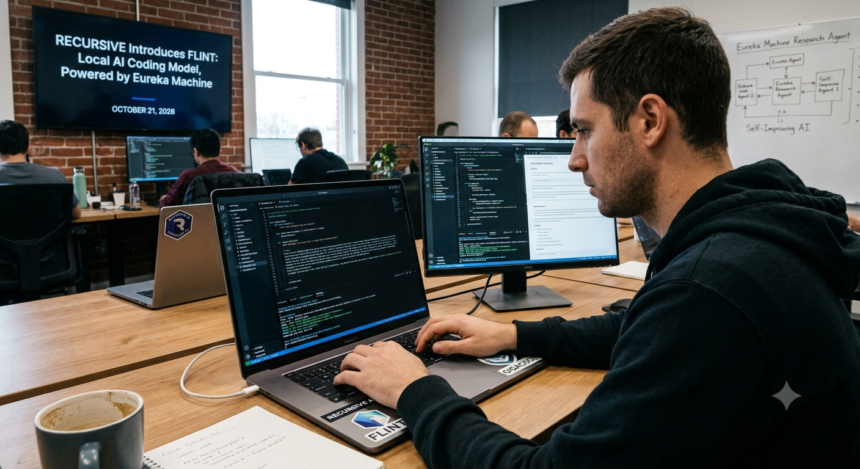
Artificial intelligence development is entering a new phase, where AI systems are not only helping people write code but also contributing to the creation of other AI models. Recursive, a startup focused on developing self-improving artificial intelligence, has introduced Flint, a free coding model that can operate directly on a laptop and was developed largely with assistance from AI.
Announced on October 21, 2026, Flint represents an early step toward Recursive’s broader ambition of building AI systems capable of improving their own research and development processes.
AI-Assisted Development Behind Flint
Recursive says its automated research platform, called the Eureka Machine, played a major role throughout Flint’s development. The system helped researchers explore ideas, conduct experiments, evaluate results, and refine the model. According to the company, a relatively small team developed Flint from scratch in less than four months.
The launch offers an early example of how AI-assisted research could accelerate model development. Rather than relying entirely on human researchers to test every approach, the Eureka Machine can evaluate different possibilities and use experimental results to guide subsequent steps.
- Advertisement -
Recursive was founded in 2025 and emerged from stealth in May 2026 with $650 million in funding at a reported $4.65 billion valuation. Its investors include GV, Nvidia, and AMD Ventures. The company is led by CEO Richard Socher, formerly Salesforce’s chief scientist.
Local Coding Without Cloud Dependency
One of Flint’s main advantages is its ability to run on a user’s own computer. Developers can download the model for free through Hugging Face under the Apache 2.0 open-source license, which permits use and modification under its terms.
Running locally offers several practical benefits. Developers can work without an internet connection, keep source code on their own devices, and reduce dependence on paid cloud-based coding services that charge according to usage.
This approach could appeal to independent developers, smaller software teams, and organizations that want greater control over their development environments.
Flint uses a mixture-of-experts architecture, activating only a portion of its parameters for each task. Although the model contains 40 billion parameters, it activates approximately 2.5 billion at a time. This design helps it deliver coding capabilities without requiring the extensive memory resources associated with some larger models.
- Advertisement -
Speed and Coding Performance
Recursive has reported encouraging performance results for Flint on consumer hardware. In the company’s tests, the model generated approximately 131 tokens per second on a MacBook Pro equipped with Apple’s M4 Pro chip. That was roughly twice the reported speed of comparable models, including Google’s Gemma 4 and Nvidia’s Nemotron 3.5 Lightning, on the same machine.
On Nvidia’s RTX Spark system, Flint exceeded 150 tokens per second.
The company also reported strong results on SWE-Bench Verified, a benchmark designed to assess how effectively AI models resolve real-world software issues. Flint reportedly outperformed other models with fewer than 50 billion parameters on this evaluation.
- Advertisement -
Across six additional tests selected by Recursive, Alibaba’s Qwen3.8 27B was the only model reported to score higher on the company’s overall average.
Early hands-on feedback has also been promising. A report by WIRED described successful attempts to use Flint for building small applications, including a to-do list and a web research tool. However, Recursive acknowledges that developers may need to provide more guidance than they would when using leading paid coding assistants. Breaking complex requests into smaller tasks can help improve results.
The Eureka Machine and Self-Improving AI
Beyond the coding model itself, Recursive’s research system is central to the company’s long-term strategy. The Eureka Machine reportedly contributed to several technical improvements, including a more efficient model architecture, low-bit training that reduced Flint’s size by 71% with minimal quality loss, and custom computing kernels designed to accelerate processing.
Recursive has not disclosed exactly how much development time these techniques saved. However, the broader industry is increasingly exploring AI agents as research assistants that can automate experiments and support scientific work.
The company’s long-term objective is to develop a system in which each new model improves the Eureka Machine’s research capabilities, helping it build subsequent models more efficiently. Human researchers would continue supervising the process and retain the ability to intervene.
What Flint Means for Developers
Flint highlights a growing opportunity for AI coding tools that prioritize local execution, affordability, privacy, and speed. Its early results suggest that smaller, efficiently designed models can deliver useful coding assistance without depending on massive cloud infrastructure.
However, the model is still an early release, and its performance across different hardware configurations and more demanding software projects will determine its practical value.
For developers, the most important development may be the combination of accessible local AI and AI-assisted model creation. If Recursive can continue improving this approach, Flint could become an example of how automated research systems help make increasingly capable coding tools faster and more affordable to develop.
The bigger question is whether AI systems can consistently help researchers build better versions of themselves while maintaining meaningful human oversight. Flint provides an early glimpse of that possibility.