

Rights reversion records are so poor that the settlement’s payout stage has become its own fight.
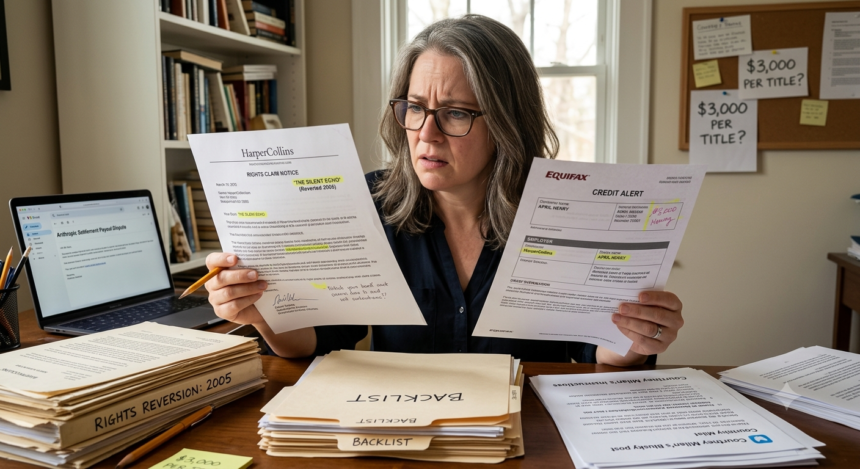
April Henry got two notices on the same day. One said HarperCollins had claimed a book whose rights reverted to her more than 17 years ago. The other was a credit alert listing HarperCollins as her employer, which it never was. She was not the only author with a strange week.
Anthropic settled a copyright class action last year for $1.5 billion. A judge had ruled that training models on copyrighted books falls under fair use, but pirating those books to do it does not. Final approval came in July, which unlocked payments. Authors of nearly 500,000 titles get $3,000 per pirated work. If a book is still in print with a traditional publisher, author and publisher split that 50-50. If it was self-published, or the publisher let it go out of print and returned the rights, the author takes all of it.
Victoria Strauss at Writers Beware says the complaints reaching her fall into two shapes: publishers claiming books whose rights reverted years ago, and publishers claiming 100% when they are owed half. She is careful about motive, saying she would rather blame recordkeeping than malice, and some publishers have already told Anthropic to fix their filings. But the volume changed her read. Authors kept reporting the identical errors, over and over, which she called systemic rather than routine. Strauss also admits she is seeing only a sliver of a very large claims process.
- Advertisement -
Authors Guild CEO Mary Rasenberger landed in a similar place in the New York Times. She does not think publishers are trying to cheat anyone. She thinks the process is confusing and the records are bad.
Then there is the stranger part. Strauss says literary agencies are also filing claims, even though agents do not hold rights in the books they sell. Author Courtney Milan, the pen name of former law professor Heidi Bond, told them on Bluesky to stop.
One detail decides many of these disputes. For an author to claim the full $3,000, the rights must have reverted before August 10, 2022, the download date named in the settlement. Miss it by a month and the split stands. The Authors Guild and Milan have both posted instructions for disputing an allocation.
If you license, syndicate, or resell content, your rights records are now a financial asset. This settlement is the first time reversion dates and print status have been converted into cash at scale, and the paperwork is failing. Audit your contract chain before the next class action names your catalog. Whoever can prove ownership fastest gets paid.
If nobody can say who owns a 20-year-old backlist title, what happens the next time an AI company writes a check?