

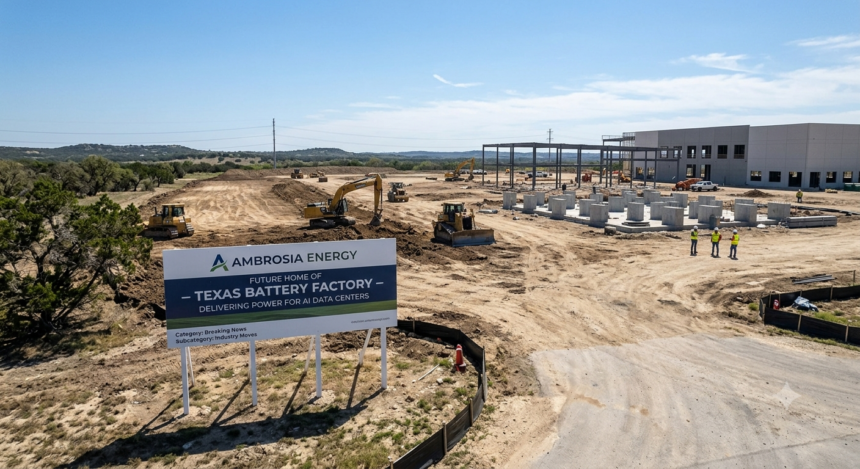
The rapid expansion of artificial intelligence is creating a major challenge for the technology industry: securing reliable electricity for increasingly power-hungry data centers. Ambrosia Energy is addressing this challenge with plans for a large-scale battery manufacturing facility in Texas, designed to support its vision of continuous, off-grid power for data centers.
The startup has started work on a 10 gigawatt-hour (GWh) battery factory near Austin, Texas, according to co-founder and CEO Ben Longmier, who announced the development at TechCrunch Disrupt in San Francisco on October 13, 2026. The facility is expected to cover approximately 150,000 square feet, with full production targeted within two to three years.
Building Battery Infrastructure for AI Growth
As AI workloads increase, data center operators need dependable electricity around the clock. Traditional grid connections can involve lengthy development timelines, while rising power demand is encouraging technology companies to explore alternative energy infrastructure.
Ambrosia Energy is developing a model that combines solar power with battery storage to deliver continuous electricity without depending entirely on the conventional grid.
- Advertisement -
Solar panels generate electricity during daylight hours, supplying data center operations while charging battery systems. The stored energy can then be used at night or during periods of reduced sunlight, helping maintain a consistent power supply.
According to Longmier, the planned factory’s annual battery production capacity could support approximately 300 megawatts of power generation at the company’s project sites.
A New Approach to Data Center Energy Costs
Ambrosia emerged from stealth in June 2026 with a strategy focused on building power plants for data centers at a target cost of approximately $100 per megawatt-hour.
The company believes that combining solar generation with battery storage can offer a cost-effective alternative to conventional power sources, including natural gas turbines that some large technology companies are considering for their expanding data center infrastructure.
Achieving this price point will depend on manufacturing efficiency, system design, battery costs, and the ability to deliver dependable electricity under different weather conditions.
- Advertisement -
Ambrosia says it is simplifying its equipment and designing battery packs in-house to reduce manufacturing expenses. Instead of purchasing complete storage systems from external suppliers, the startup buys existing battery cells and assembles its own packs.
This approach allows the company to reduce component complexity and potentially improve cost efficiency as production scales.
First Commercial Power Plant Planned in West Texas
Alongside its manufacturing plans, Ambrosia is preparing to begin work on its first commercial power plant in West Texas later in 2026.
- Advertisement -
The proposed facility will combine 300 megawatts of solar capacity with 660 megawatt-hours of battery storage. Its intended output is 30 megawatts of continuous electricity, with a targeted uptime of 99.3%.
The company has also been testing its technology through a pilot installation capable of generating 200 kilowatts of electricity continuously. Longmier said portions of the pilot facility had operated for more than 100 days.
These early operating results provide a foundation for the company’s larger projects, although commercial-scale performance and costs will need to be demonstrated as deployment expands.
What This Means for the Data Center Industry
Ambrosia’s plans highlight a growing shift in how technology companies approach energy infrastructure. Rather than relying exclusively on utility connections, data center developers may increasingly evaluate dedicated renewable power plants and integrated battery storage.
For AI companies, reliable electricity is becoming a strategic requirement. Delays in securing power can affect data center construction, computing capacity, and the speed at which new AI services reach the market.
For the energy sector, this creates opportunities in battery manufacturing, renewable generation, energy management, and infrastructure designed specifically for high-demand computing facilities.
However, challenges remain. Battery installations require significant upfront investment, and renewable energy systems must be carefully sized to handle periods of limited solar generation. Delivering consistent power at competitive prices will be essential to proving the model’s commercial viability.
The Road Ahead
Ambrosia Energy’s planned Texas factory represents an ambitious attempt to connect battery manufacturing directly with the growing electricity needs of AI infrastructure. If the company reaches its production targets and demonstrates competitive operating costs, its approach could become an important option for data center operators seeking dependable power.
The next milestones will be the development of its first commercial plant, progress toward full factory production, and evidence that its solar-plus-storage model can deliver reliable electricity at the promised cost.
As AI infrastructure continues to expand, the companies that solve the challenge of affordable, continuous power could play an increasingly important role in the technology industry’s next phase of growth.