


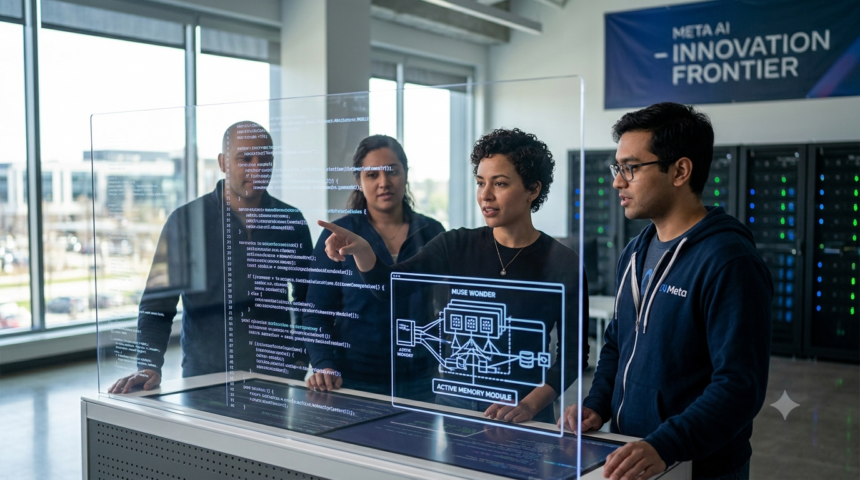
Meta is taking a bigger step into advanced artificial intelligence with the launch of Muse Wonder and Muse Wonder Full, two new models developed by its Superintelligence Lab. The release signals a shift toward more powerful AI systems designed to handle demanding tasks, improve reasoning, and support more personalized digital assistants.
Unlike the earlier Muse Spark model, which focused on lightweight performance and low latency, the new models prioritize greater capability and stronger results on complex workloads. Meta says the launch represents an important stage in its broader ambition to develop AI that can better understand and assist individual users.
A Bigger Push Toward Advanced AI
According to Meta, Muse Wonder and Muse Wonder Full deliver benchmark results comparable to several leading competing models, including Fable 5.1 and GPT-6 Astra. The company has highlighted improvements in areas such as coding and other complex problem-solving tasks.
The two-model approach also reflects different access strategies. Muse Wonder will be available through Meta’s Model API, while Muse Wonder Full will be reserved for subscribers to Muse Code. The larger model will not be offered through the API, according to the launch announcement.
- Advertisement -
Pricing for Muse Wonder is set at $4 per million input tokens and $20 per million output tokens. This places the model in a premium pricing category alongside other advanced AI offerings, making performance, reliability, and practical business value important considerations for potential users.
Why Memory Could Make the Difference
One of the most notable features of the new models is what Meta calls active memory. The concept focuses on helping AI systems retain and connect relevant information shared by users over extended periods.
For businesses and individuals, this capability could make AI assistants more useful beyond individual prompts. Rather than repeatedly explaining preferences, project details, or ongoing tasks, users could benefit from systems that maintain context and build on previous interactions.
Meta has pointed to MemoryBench, a benchmark designed to assess memory construction and continual learning, as evidence of progress in this area. The company reports that Muse Wonder outperforms several competing models on this evaluation.
If these capabilities translate into everyday use, persistent memory could become an important differentiator in the increasingly competitive AI assistant market. However, practical performance will depend on factors such as accuracy, privacy protections, and how effectively models retrieve relevant information without introducing incorrect details.
- Advertisement -
What the Launch Means for AI Agents
Both Muse Wonder models will help power Meta’s Muse agent, connecting the new model capabilities with AI-driven task execution.
For enterprise technology teams, increasingly capable AI agents could create opportunities to automate research, support software development, organize information, and manage multistep workflows. Persistent context may also help agents maintain continuity when tasks extend across multiple sessions.
Still, stronger models alone do not guarantee reliable automation. Businesses will need to evaluate output quality, integration options, security controls, operating costs, and human oversight before deploying these systems in critical workflows.
- Advertisement -
Meta Repositions Its AI Strategy
The release marks Meta’s first frontier-model launch following a broader restructuring of its AI operations led by Alexandr Wang, the founder of Scale AI. Since that strategic shift, Meta has introduced Muse Spark and the Muse agent while building toward more advanced model capabilities.
The new models were trained at Meta’s Prometheus data center in central Ohio, which became operational earlier in 2026.
This development places Meta more directly in competition with organizations pursuing increasingly capable AI systems. The next challenge will be turning benchmark performance into products that users and businesses can trust.
The Road Ahead
Muse Wonder represents a significant development in Meta’s effort to expand its AI portfolio beyond lightweight models. Its emphasis on advanced task performance, persistent memory, and agent-based experiences highlights where the company sees opportunities for future growth.
For the wider technology industry, the launch reinforces a broader trend: competition is moving beyond generating quick responses toward building AI systems that can understand context, support ongoing work, and assist users over time.
Whether Meta can turn these ambitions into dependable real-world experiences will be an important measure of its progress in the frontier AI race.