

Fifteen years of operations discipline and quiet diplomacy built the run; AI, Europe and China are what Ternus inherits.
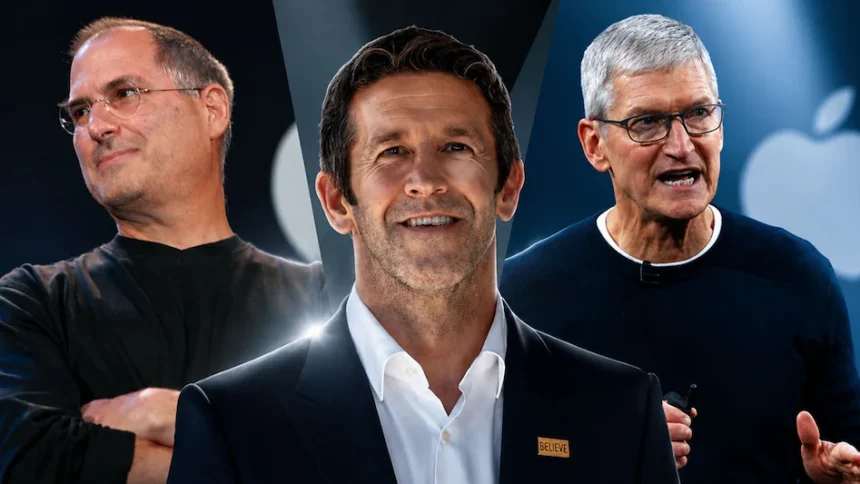
Apple’s stock has climbed more than 2,000% since Tim Cook took over in August 2011. In July the company briefly touched a $5 trillion valuation, only the second ever to do it. On September 1, hardware engineering chief John Ternus takes the job. He inherits the machine and the bill.
Cook came in with an operations and supply chain résumé, not a stage presence. That turned out to be the point. Over fifteen years he made the iPhone the thing you use to buy coffee, play music, track a workout and pay a credit card bill, built on the services and accessories he pushed. David Yoffie, a Harvard Business School professor who wrote a case study on Cook and Apple, said nobody expected the iPhone could scale that far. Ron Johnson, who ran Apple retail from 2000 to 2011, remembers him as the executive who listened before speaking in weekly meetings with Jobs.
Gene Munster of Deepwater Asset Management, who has tracked Apple since 2004, describes Cook as a statesman as much as a chief executive. The tariff episode shows why. Pressed to build phones in America, Apple instead pledged $600 billion to expand its US operations, including making critical iPhone components domestically. Trump has said Cook was one of the few business leaders who called him personally during his first term. Jeffrey Sonnenfeld of the Yale School of Management, a former White House advisor, puts Cook near the top of the CEOs Trump respects. Cook also moved some production out of China without losing Chinese customers or Beijing’s goodwill. Munster says he still isn’t sure how that was possible.
- Advertisement -
The handover comes with four open problems. Europe is Apple’s second-largest market, which makes regulatory friction there expensive rather than annoying.
- China exposure: Covid and tariffs both showed how much still depends on it.
- European friction: App Store rules already forced changes; the new Siri skips the region.
- AI catch-up: Vision Pro disappointed, and pressure to close the gap keeps building.
- Rising costs: A memory chip shortage from the AI race is lifting prices.
None of it is new. All of it now lands on a hardware engineer rather than an operator who spent a decade building political cover.
Cook’s parting advice on an April earnings call was narrow and old-fashioned: build products that enrich people’s lives, and the rest follows.
The real test of Cook’s legacy is whether the next CEO also has to be a diplomat.