


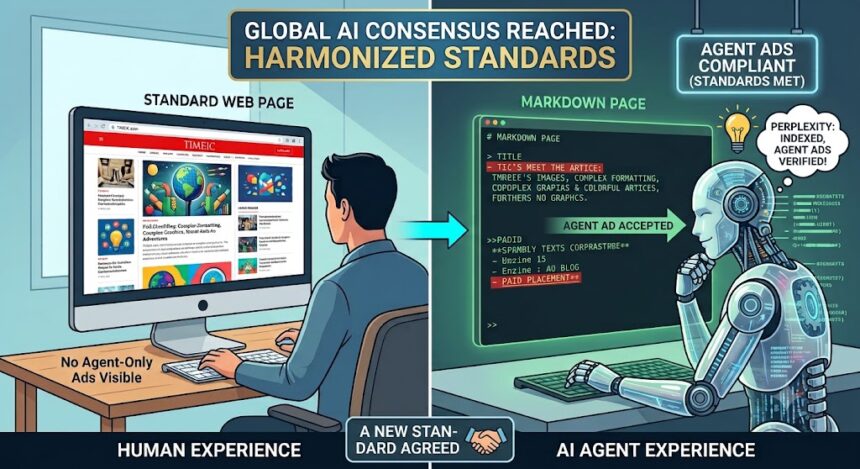
A publisher started selling ads that only AI crawlers can see. Perplexity blocked them. The fight that follows will decide how brands are allowed to talk to machines.
What happened
Time began inserting advertising into the markdown versions of its articles — the stripped-down, text-only renderings that AI crawlers fetch instead of the visually formatted page a human sees. The ad units are built as sponsored FAQ blocks, written and approved by the advertiser, and labelled as paid placement. Readers visiting timeic.com never encounter them. Only the machines do.
The format was developed with adtech firm Mobian. Ally Bank and the Project Management Institute signed on as early testers. Time sells one agent-facing ad per markdown page and lets buyers target specific content or date windows. Pricing has not been made public.
Perplexity’s response was blunt: it blocked the material from influencing its search index and its agents, called the practice deceptive, and warned that publishers running similar formats could see their reputation and trust scores fall inside its index.
- Advertisement -
Independent testing reported by The Register found the split was real. ClaudeBot, OAI-SearchBot and PerplexityBot were served pages carrying sponsored content. Google’s standard search crawler received the same HTML a human visitor gets.
Mobian’s CEO Jonah Goodhart rejected the “deceptive” framing, arguing the format simply hands AI systems current, brand-verified information that the model is free to ignore.
Nobody else has picked a side. OpenAI and Google declined to say whether they’d follow Perplexity’s lead. Anthropic didn’t respond. Time’s COO says the publisher has approached Perplexity directly to work out standards.
Why this is bigger than one ad unit
Strip away the specifics and this is a fight about cloaking — the twenty-year-old sin of showing search engines something different from what you show people.
Google’s own definition is narrow: different content for users and crawlers, served with intent to manipulate rankings and mislead. Its spam policies now explicitly extend to manipulating generative AI responses in Search. But Google has not said Time’s format breaks those rules, and that silence is the whole story. The rulebook for classic SEO doesn’t cleanly map onto a page written for a reasoning model rather than a ranking algorithm.
- Advertisement -
Both readings are defensible, which is exactly the problem:
- Perplexity’s view: any divergence between the human page and the machine page is manipulation by construction. The crawler is a proxy for the user, so deceiving the crawler deceives the user.
- Mobian’s view: markdown is a format, not a disguise. Feeding a model accurate, first-party, clearly-labelled brand information is a correction to hallucination, not an attack on it.
There is currently no arbiter. The IAB published an AI Transparency and Disclosure Framework in January, but it addresses AI-generated or AI-altered advertising shown to people. It says nothing about advertising delivered to a crawler. The category has outrun its own standards body by about a year.
The number that explains the urgency
Adobe Analytics measured a 393% year-on-year jump in traffic from generative AI sources to US retail sites between January and March 2026.
- Advertisement -
That’s clicks from AI surfaces to websites — not ad performance. But it tells you why publishers are experimenting and why brands are buying. The assistant layer has stopped being a curiosity in the traffic report and started being a channel. Wherever a channel forms, an inventory market forms behind it. Time isn’t being reckless; it’s being early.
Meanwhile the platforms are quietly building the sanctioned version of the same thing. OpenAI takes structured product feeds from merchants — descriptions, images, prices, reviews, availability — for ChatGPT product discovery, runs a dedicated OAI-AdsBot for advertiser landing pages, and began testing ads inside ChatGPT in February. The message underneath all of it: there will be a door for commercial information, and we will decide where it is.
Perplexity’s block is the enforcement of that principle. Sponsored content reaching a crawler guarantees nothing about whether it reaches a user.
What B2B marketers should actually do with this
1. Audit what your crawlers are being served. Most marketing teams have never checked whether their own site returns different content to an AI agent than to a browser. Headless CMSs, markdown endpoints, llms.txt files, JSON-LD blocks and personalisation layers can all create divergence you never intentionally authorised. Find out before someone else does.
2. Treat parity as the safe default. Until a standard exists, the only unambiguously defensible position is that the machine version and the human version say the same things. Format can differ. Claims cannot.
3. Separate structured facts from paid placement. Publishing accurate, machine-readable data about your pricing, integrations, certifications and support terms is good practice — arguably the highest-ROI technical content work available right now. Paying a third party to inject brand messaging into their crawler-only pages is a different activity with a different risk profile. Don’t let a vendor blur the two in a deck.
4. Price the platform risk into any agent-ad test. This experiment produced an index penalty within weeks. If you buy AI-crawler inventory in 2026, assume a non-trivial chance the placement is neutralised — and a smaller but real chance it damages how a platform scores the publisher you associated with.
5. Watch who moves next. Perplexity has the smallest distribution of the major AI search players and the most to gain from a trust-first position. The real signal comes when Google or OpenAI states a policy. That’s the moment agent advertising either becomes a legitimate line item or a cautionary tale.
Advertising to machines is now technically trivial and normatively undefined. That gap is where the next eighteen months of AI marketing strategy will be decided — and the first firm to build a reputation for showing agents exactly what it shows people will find that boring consistency turns into an unexpectedly durable advantage.