


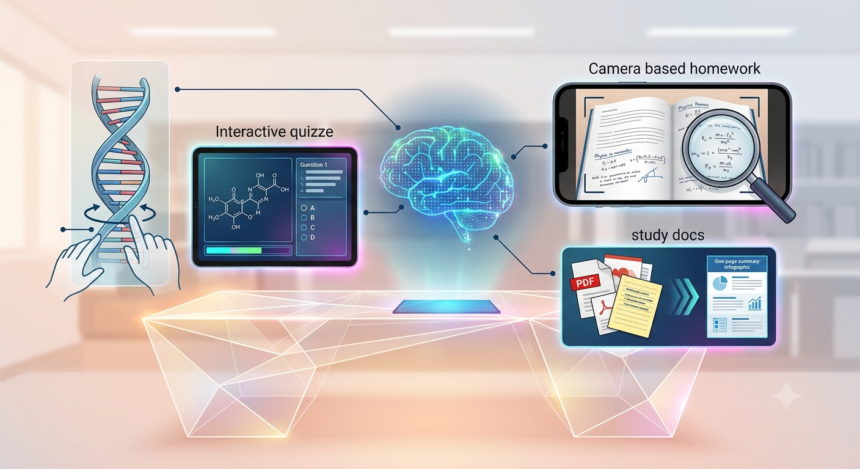
Google rolled out a broad set of learning features across Search and Gemini on Wednesday — interactive visuals generated on the fly, functional 3D simulations, personalized practice quizzes, a camera-based homework helper, and a dedicated study hub inside the Gemini app.
Read as a product update, it’s a feature dump. Read as strategy, it’s Google planting a flag on the student desktop before OpenAI does — and before purpose-built study apps like Knowt and Gauth turn a niche into a habit. Students are one of the stickiest AI cohorts there is: they use these tools daily, for years, and they carry the habit into their working lives.
What’s new inside Search
Visuals that get built for your question. Search a concept like “pH scale” and the AI Overview can now assemble an interactive visual instead of a wall of text. Push further — say, asking where different citrus fruits land on that scale — and AI Mode generates a custom interactive experience built around that specific follow-up.
Quizzes on demand. Students can now ask Search to generate practice tests on more or less anything — sciences, math, humanities, languages. A prompt as loose as “quiz me on the vocabulary that shows up most on the SAT” returns a working interactive quiz.
- Advertisement -
Lens as a homework tutor. Rolling out over the coming weeks: point the Lens camera in the Google app at a problem you’re stuck on, and Google will walk through the underlying concept, flag where the reasoning went wrong, and nudge you toward the next step rather than just handing over an answer.
Study docs from your own material. Upload PDFs, slide decks, documents, or even a photo of handwritten notes, and Search will compress them into a one-page summary of the key concepts.
What’s new inside Gemini
Research that runs while you don’t. Gemini can now kick off a multi-step research report in the background. Close the chat, go do something else, and you’ll get a notification when it’s ready — then talk through the findings out loud in Gemini Live and ask follow-ups by voice.
Working 3D simulations. Responses can now include tables, grids, and functional 3D models generated for the specific prompt. Ask to see how DNA works in 3D and you get a structure you can actually rotate and zoom into.
A dedicated learning hub. The Gemini app is getting a single destination for all of it — study notebooks, flashcards, practice quizzes, and the rest, gathered in one place instead of scattered across features.
- Advertisement -
Why this matters beyond the classroom
Three things worth flagging if you build products, content, or demand gen:
Search results are becoming applications. An AI Overview that renders a manipulable pH scale isn’t a link to a page — it’s a small piece of software. If your content strategy assumes the destination is a click-through, that assumption is thinning out further.
“Explain it” is becoming “show it.” Generated simulations reset expectations for what a good explanation looks like. Static diagrams in your docs, onboarding, and top-of-funnel content will start feeling dated faster than most teams expect.
- Advertisement -
Student habits become buyer habits. The interface people learn on tends to be the interface they trust later. Google isn’t chasing education revenue here — it’s chasing default status.
Google is betting that the assistant students learn with becomes the assistant they keep. OpenAI is making the same bet. The winner won’t be decided by the flashiest 3D model — it’ll be decided by which tool gets opened at 11pm the night before an exam.
Was this useful? Forward it to someone who’s still explaining things with static screenshots.