

The race to rebuild critical manufacturing capacity in the United States is expanding beyond semiconductors, batteries, and robotics. Electric motors are now becoming another important part of that conversation, and startup Modal Motors is taking a different approach.
Rather than simply moving existing motor production from China to the U.S., the company is developing motor technologies designed to reduce or eliminate dependence on rare-earth magnets, a part of the supply chain where China has significant influence.
A Different Approach to Reshoring
Modal Motors was founded by Michael Van Steenburg, an engineer with decades of experience in the automotive and electric motor industries. His latest venture is based on the idea that relocating manufacturing alone may not solve the underlying supply-chain problem.
Many modern electric motors depend on permanent magnets containing rare-earth materials. While manufacturers can potentially produce motors domestically, securing a reliable domestic supply of these materials and the magnets made from them remains a major challenge.
- Advertisement -
Van Steenburg believes the industry needs to rethink the motor itself.
Instead of reproducing conventional Chinese motor designs in American factories, Modal Motors is working on technologies that can operate without relying on the same rare-earth-heavy architecture.
Why Rare-Earth Materials Matter
Rare-earth elements are used in many high-performance electric motors because they can help achieve strong torque and efficiency while keeping motors relatively compact.
The problem is not simply access to the minerals. Mining, processing, refining, magnet production, and manufacturing are all parts of a complex global supply chain.
China has built a dominant position across significant portions of that ecosystem. Recent restrictions and disruptions involving rare-earth products have increased attention around the vulnerability of companies that depend on these materials.
- Advertisement -
For manufacturers of drones, robotics, electric vehicles, industrial equipment, and other technologies, supply-chain reliability can therefore become a strategic consideration alongside cost and performance.
Two Motor Designs Under Development
Modal Motors is currently developing two motor concepts.
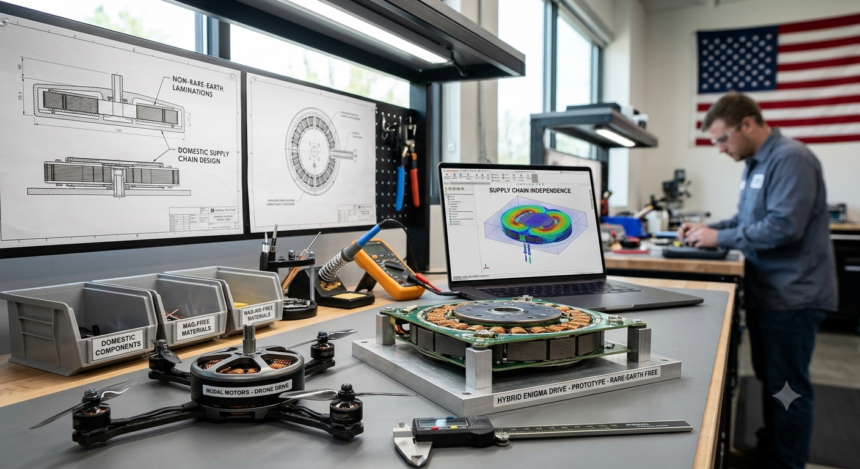
The first is a compact electric motor aimed primarily at drones. The same basic technology could potentially be used in applications such as fans, blowers, and actuators.
- Advertisement -
The company is targeting high torque density and efficiency while keeping the motor lightweight, characteristics that are particularly valuable for drones and other systems where every gram matters.
The second design is more unconventional. Modal calls it the Hybrid Enigma Drive, a flat or planar motor architecture designed for applications where conventional cylindrical motors may not fit easily.
A flatter form factor could create opportunities for equipment designers working with limited installation space or demanding mechanical configurations.
Experience Behind the Technology
Van Steenburg’s approach is informed by a long career in the automotive sector. His previous work included electric and hybrid drivetrain technology, giving him experience with the engineering challenges involved in developing motors for demanding applications.
Interestingly, his career also has a connection to China’s automotive ambitions.
During the late 1990s, Van Steenburg worked on a hybrid gas-electric drivetrain project that China was interested in using for its emerging domestic automobile market. Decades later, he is working on technology intended to reduce dependence on China’s industrial supply chain.
That contrast illustrates how dramatically the global technology landscape has changed.
Beyond Moving Factories
The bigger question raised by Modal Motors is whether supply-chain independence can be achieved simply by relocating factories.
For critical technologies, manufacturing location is only one piece of the puzzle. Access to minerals, component suppliers, processing capabilities, specialized equipment, engineering talent, and production infrastructure can all influence how resilient a supply chain actually is.
Modal Motors is betting that changing the underlying technology could be another way to address the problem.
Its strategy reflects a broader movement toward designing products around supply-chain resilience from the beginning, rather than attempting to remove dependencies after a product has already been commercialized.
What Comes Next
Modal Motors is still developing its products, so the company’s long-term commercial impact remains to be established. Performance, manufacturing costs, scalability, reliability, and customer adoption will ultimately determine whether its designs can compete with established electric motor technologies.
However, the company’s approach highlights an important shift in hardware innovation.
The future of reshoring may not simply involve producing the same products in a different country. In some industries, it could require redesigning the products themselves around materials, components, and manufacturing processes that are easier to source domestically.
For electric motors, Modal Motors is attempting to make that redesign the starting point rather than the end goal.