


- Clipto, a three-year-old startup with offices in San Francisco, Hong Kong and Singapore, closed a $15M all-equity round at a $250M post-money valuation.
- Backers include HSG (formerly Sequoia China), GL Ventures, EnvisionX Capital, Palm Drive Capital, 522 Ventures, Hans Tung and Lu Zhang.
- The company hit $15M ARR at the start of 2026 and says it is profitable on a net-income basis — with just over 20 employees.
- Everything runs on-device. No cloud round-trip for indexing or search.
- Two weeks ago it shipped MCP support, letting ChatGPT, Claude and other assistants query your local media library directly.
What it actually does
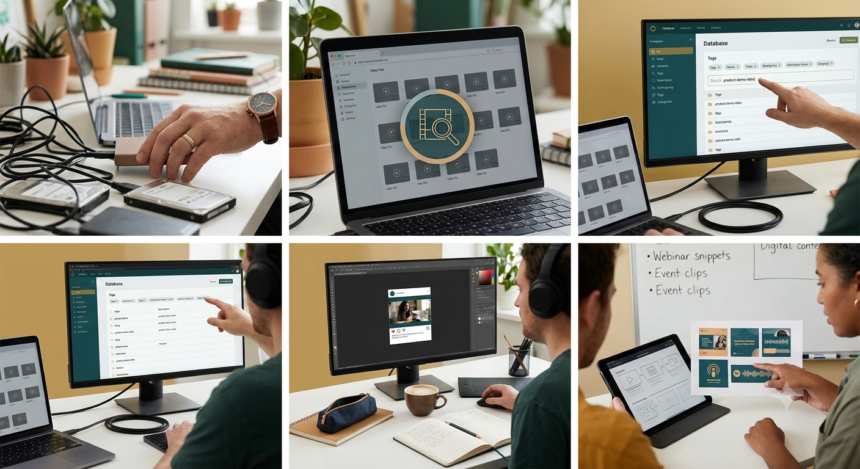
Most of the money in generative AI has gone toward making more stuff. Clipto went the other direction: it builds an index of the video, audio, images, screen recordings, meeting captures and documents already sitting on your machine, then lets you retrieve any of it by describing it in plain language.
The founder’s framing is blunt. Henry Kang argues the real problem of the AI era isn’t scarcity of content but excess of it — footage piling up unused on people’s drives. In his words, “we don’t have a content shortage.”
The lineage is unusually consistent. Kang worked on robots at Carnegie Mellon in 2006 that recorded their environment, recognised objects and remembered where things were. He then built a wardrobe-tagging app, then ZenVideo, which Tencent acquired in 2020. Clipto is the same retrieval problem pointed at a hard drive.
Note the audience drift, because it’s the tell: Clipto launched for video creators drowning in B-roll, but creators are now only about a quarter to a third of the user base. The rest are lawyers, clinicians, researchers, HR teams, professors, students — and marketers. This started as a creator tool and became a knowledge-work tool without changing the product thesis.
- Advertisement -
The numbers deserve a second look
A $250M valuation against $15M ARR works out to roughly a 17x revenue multiple, and the company says it reached profitability within three months of starting operations. Subscriptions run around $9/month, and the round follows back-to-back Pre-A raises through 2025 and early 2026.
Run that math. Twenty-odd people. Nine dollars a month. Hundreds of thousands of paying subscribers out of a claimed 30 million lifetime users. Profitable before the raise, not after.
That’s a consumer-priced, prosumer-monetised, sub-30-person business — and it is the shape a lot of AI companies are quietly converging on. Not a land-grab. A wedge, priced low, sold direct, with the compute cost pushed onto the customer’s own silicon.
⚠️ One caution for anyone citing this: the disclosed figures are company-provided. Kang declined to break out exact subscriber counts or ARPU. Coverage of the raise also varies — some outlets report the round size as undisclosed, others as $15M. Treat the ARR and user numbers as directional.
The MCP move is the actual story
The funding is the headline. Model Context Protocol support is the strategy.
- Advertisement -
By exposing its local index through MCP, Clipto stops being a search app and becomes a retrieval layer that other AI systems call. You don’t go to Clipto to find the clip — you ask Claude, and Claude asks Clipto. Access requires the user’s active request and authorisation, retrieval is bounded to the scope the user defines, and processing stays on the device without cloud services.
For B2B teams, that architecture matters more than the feature list. Local-only processing removes the single biggest blocker in enterprise AI procurement conversations: where does our footage go, and who trains on it? If the answer is “nowhere, and nobody,” the security review gets a lot shorter.
This is also the emerging pattern worth watching. The valuable position in an agent-driven stack isn’t the chat interface — it’s being the thing the agent has to call to get at data it can’t otherwise reach.
- Advertisement -
Feature or product? The open question
Clipto is walking into territory the incumbents already occupy.
Adobe shipped Media Intelligence in Premiere Pro, which recognises objects, locations and camera angles automatically and returns matching clips from natural-language queries. Adobe runs that analysis entirely locally, doesn’t train on user footage, and stores the visual index in a project file. Apple Photos and Google Photos have offered descriptive search for years. Google has been extending Personal Intelligence in AI Mode across nearly 200 countries, letting people connect Gmail and Google Photos into search.
Clipto’s differentiation is scope, not capability. Premiere’s search only reaches media inside the open project — Apple and Google only reach their own libraries. Clipto indexes across formats and across the whole machine, then makes that index callable by third-party agents.
Whether that’s a durable moat or a temporary gap is the $250M question. The honest read: it’s a gap, and the incumbents can close it. The bet is that Clipto locks in the agent integrations and the cross-format habit before they bother.
What to take from this if you run marketing or content ops
1. Your dead archive is a live asset. Most teams have years of webinar recordings, event footage, customer call captures and podcast masters that nobody can search, so nobody reuses. Retrieval, not generation, is the cheapest content unlock available to you right now.
2. Audit before you tool up. Before buying anything, quantify it: hours of unindexed video, number of storage locations, average time to find a specific clip. That number is your business case.
3. On-device is becoming a sales argument, not just an architecture. If you sell AI-adjacent products, local processing is now a procurement advantage you can put on a slide.
4. Build for the agent, not just the user. MCP support turned a search app into infrastructure. If your product holds data an assistant would want, being callable is fast becoming table stakes.
5. Small teams, real revenue. Twenty people, profitable, $15M ARR. The team-size-equals-seriousness heuristic is finished.