

By using this site, you agree to the Privacy Policy.
Accept
Content LeadContent Lead
  • Home
  • Latest News
  • Technology
  • Business
  • Marketing
  • White Paper
  • Event
  • Contact Us
Reading: Google Home Opens the Door to AI Agents With New MCP Integration
Share
Aa
Content LeadContent Lead
Aa
Search
  • Home
  • Latest News
  • Technology
  • Business
  • Marketing
  • White Paper
  • Event
  • Contact Us
Follow US
© 2024 - All Right Reserved by Content Lead
- Advertisement -
Home » Blog » Google Home Opens the Door to AI Agents With New MCP Integration
Artificial IntelligenceLatest News

Google Home Opens the Door to AI Agents With New MCP Integration

Sunil Pachori
Sunil Pachori
Share
5 Min Read
Google Home Opens the Door to AI Agents With New MCP Integration

AI agents are moving beyond browsers, coding environments, and productivity apps. Google is now giving them a pathway into the smart home.

Contents
AI Agents Are Coming to the Smart HomeMCP Provides the ConnectionSetting It Up Requires Some Technical WorkPremium Subscribers Get Access FirstAI Agents Are Expanding Beyond the Screen

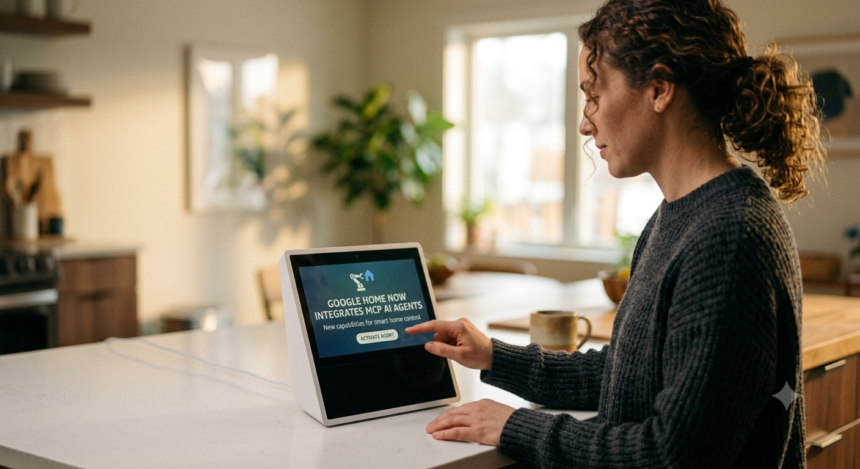
Google has launched early access to a Model Context Protocol (MCP) server for Google Home, allowing compatible AI agents to securely interact with connected smart-home devices and access relevant event history.

The integration means AI assistants that support MCP — including Claude, Hermes, OpenClaw, ChatGPT, and Google’s Antigravity — can potentially become a new conversational control layer for the home.

Instead of opening different apps or configuring individual automations, users could simply describe what they want their AI agent to do.

- Advertisement -

AI Agents Are Coming to the Smart Home

The biggest change is the ability to connect general-purpose AI agents with devices already managed through the Google Home ecosystem.

Once configured and authorized, users can give their agent natural-language instructions to perform tasks such as controlling connected devices, reviewing camera summaries, monitoring recent smart-home activity, or creating customized dashboards.

This could make smart-home automation significantly more flexible.

Rather than relying exclusively on predefined commands and routines, an AI agent could interpret a broader request, understand the available context, and help the user interact with multiple connected systems.

The integration is designed to support devices throughout the Google Home ecosystem, including Google Nest thermostats and doorbells, as well as compatible Matter and “Works with Google Home” products such as smart lights.

- Advertisement -

MCP Provides the Connection

The technology making this possible is Model Context Protocol.

MCP provides a standardized way for AI applications and agents to communicate with external tools, services, and data sources.

Google already supports MCP across several parts of its technology ecosystem, including Google Cloud, Workspace, developer tooling, and data platforms.

- Advertisement -

Bringing MCP to Google Home extends that approach into a much more consumer-oriented environment.

That’s significant because an AI agent isn’t simply retrieving information anymore. With appropriate authorization, it can potentially interact with devices in a user’s physical environment.

Setting It Up Requires Some Technical Work

The early-access implementation isn’t completely plug-and-play.

Users first need to create a Google Cloud project and configure it for Home MCP.

They can then provide the MCP configuration information to a compatible AI agent and ask the agent to complete the connection process. During setup, users will be prompted to sign into their Google account and grant the required permissions.

Google is also providing documentation through the Google Home Developer Center.

The permission stage will be particularly important. Connecting AI agents to cameras, thermostats, lights, and home-event information introduces a different level of privacy and security consideration compared with giving an assistant access to a basic productivity application.

Premium Subscribers Get Access First

Google isn’t immediately making Home MCP available to everyone.

Early access is rolling out in the United States to subscribers of Google Home Premium Advanced, the company’s higher-end subscription priced at $20 per month.

That plan already provides features such as longer event-based video history, detailed alerts, descriptive notifications, video-history search, and daily summaries.

The rollout begins now and will continue over the coming weeks.

Google hasn’t confirmed whether Home MCP will eventually become available to lower-priced subscription tiers or expand into additional countries.

During the early-access period, the company is also seeking feedback from developers and early adopters through its Smart Home for Developers Community.

AI Agents Are Expanding Beyond the Screen

The bigger story isn’t simply another Google Home feature.

MCP is helping transform AI assistants from systems that answer questions into agents capable of interacting with external services — and now physical devices.

Imagine asking one agent to review what happened around your home, summarize relevant camera events, adjust connected devices, and organize that information into a personalized dashboard.

That’s considerably different from issuing individual voice commands to a traditional smart assistant.

As MCP adoption expands, smart homes could gradually shift from collections of individually controlled devices toward environments coordinated by intelligent agents.

Google Home’s new MCP integration offers an early glimpse of that future: AI agents that don’t just understand your requests — they can interact with the connected world around you.


You Might Also Like

The AI Graveyard Is Growing: What Failed AI Products Can Teach the Industry

ClickFix Attacks Are Tricking Mac and Windows Users Into Infecting Their Own Computers

Scammers Target Hundreds of Thousands of Crypto Users After Trezor Vendor Breach

Instagram Hands Your Grid Over to Photos You Didn’t Post

Apple’s First Fold Costs $1,999. The Watch Now Listens

TAGGED: AI Agents, Antigravity, ChatGPT, Claude, Google Cloud, Google Home, Google Nest, Home Automation Security, Internet of Things (IoT), Matter Protocol, Model Context Protocol (MCP), Smart Home Automation
Sunil Pachori September 16, 2026 September 16, 2026
Share This Article
Facebook Twitter Whatsapp Whatsapp LinkedIn
Previous Article The AI Graveyard Is Growing What Failed AI Products Can Teach the Industry The AI Graveyard Is Growing: What Failed AI Products Can Teach the Industry
Leave a comment

Leave a Reply

Your email address will not be published. Required fields are marked *

Latest News

The AI Graveyard Is Growing What Failed AI Products Can Teach the Industry
The AI Graveyard Is Growing: What Failed AI Products Can Teach the Industry
Latest News Technology September 15, 2026
ClickFix Attacks Are Tricking Mac and Windows Users Into Infecting Their Own Computers Cybercriminals are increasingly using a surprisingly simple technique to compromise computers convincing victims to execute the malicious code themselves. Known as ClickFix, the attack method is emerging as a significant cybersecurity threat affecting both Windows and macOS users. Instead of relying entirely on software vulnerabilities or secretly installing malware, attackers use social engineering to persuade users to copy and execute commands directly on their computers. A recent campaign involving fake HBO Max advertisements on Reddit demonstrates how convincing these attacks can become when criminals gain access to trusted accounts. What Is a ClickFix Attack A typical ClickFix attack begins when someone visits a malicious website or a legitimate website that has been compromised. The page may display what appears to be a normal CAPTCHA, verification request or anti-bot security check. The user is told that an additional step is required before they can continue. Instead of simply clicking a checkbox, however, the website provides instructions asking the visitor to copy a command and paste it into Windows Command Prompt or PowerShell, or Terminal on macOS. That should immediately be considered a major warning sign. Once the command is executed, it can download and install information-stealing malware on the device. The malware may then attempt to collect sensitive information including saved passwords, browser sessions, authentication data and cryptocurrency wallet information. What makes ClickFix particularly dangerous is that the victim performs the critical execution step. Because command-line tools provide direct access to operating-system functions, malicious activity initiated this way can sometimes bypass or complicate traditional security defenses. HBO Max Reddit Account Used in Malicious Campaign One of the latest ClickFix incidents involved advertisements appearing to originate from an official HBO Max account on Reddit. Security researchers found advertisements directing users toward websites designed to resemble legitimate HBO Max pages. The sites then presented visitors with ClickFix-style instructions intended to convince them to execute malicious commands. The situation was particularly concerning because attackers were not simply impersonating HBO Max with a newly created profile. Reddit confirmed that an HBO Max account authorized to run advertising on the platform had been compromised and subsequently used to distribute advertisements containing malicious links. Reddit said it locked the affected account and removed the advertisements after discovering the incident. The total scale of the campaign remains unclear. Reddit did not disclose how many people saw or interacted with the malicious advertisements, and it is not known how many computers may have ultimately been infected. Why ClickFix Is So Effective ClickFix demonstrates an important shift in modern cybercrime. Instead of breaking through a computer's defenses directly, attackers manipulate users into performing actions that would normally require malware or an exploit. CAPTCHAs and verification screens are now common parts of browsing the internet, which makes a fake security check appear familiar and potentially trustworthy. The use of legitimate or previously trusted accounts makes the attack even more convincing. Cybercriminals are essentially combining malvertising, account compromise, phishing and social engineering into a single attack chain. How Users Can Protect Themselves The most important rule is simple never paste an unfamiliar command into Terminal, PowerShell or Command Prompt because a website tells you to. Legitimate CAPTCHA systems do not normally require users to open operating-system command-line tools and execute copied code. Users should also remain cautious even when an advertisement appears to come from a verified or recognizable brand. A legitimate account can itself be compromised. Organizations managing Windows environments can consider restricting command-line access where employees do not need it. Security researcher Kevin Beaumont has noted that organizations can apply controls across managed Windows environments to reduce opportunities for this type of exploitation. Mac users can also consider security tools designed to detect persistent software installations and suspicious system changes. The Bigger Cybersecurity Lesson ClickFix attacks highlight a fundamental challenge for cybersecurity sophisticated malware isn't always necessary when attackers can convince people to execute malicious instructions themselves. As criminals increasingly combine trusted brands, compromised accounts, convincing websites and familiar verification interfaces, users need to evaluate not only what they click, but also what a website asks them to do afterward. If a website suddenly asks you to open Terminal, PowerShell or Command Prompt and paste a command, stop. That “verification” could actually be asking you to hack your own computer.
ClickFix Attacks Are Tricking Mac and Windows Users Into Infecting Their Own Computers
Latest News Security September 14, 2026
Scammers Target Hundreds of Thousands of Crypto Users After Trezor Vendor Breach
Latest News Security September 11, 2026
Instagram Hands Your Grid Over to Photos You Didn't Post
Instagram Hands Your Grid Over to Photos You Didn’t Post
Applications Latest News September 10, 2026
Content-Lead is a vibrant community that brings together professionals passionate about marketing strategy and the latest in marketing technology. With over 1 million members, it has rapidly become a key player in helping businesses navigate the complex world of modern marketing. By focusing on both strategy and technological innovation, Content-Lead equips its members with the tools and insights needed to drive impactful advertising campaigns.
Facebook X-twitter Linkedin

Quick Link

Menu
  • Home
  • Latest News
  • Technology
  • Business
  • Marketing
  • White Paper
  • Event
  • Contact Us

About US

Menu
  • Privacy Policy
  • GDPR Policy
  • Terms of Use

Subscribe to Our Newsletter

© 2026 – All Right Reserved by Content Lead.