


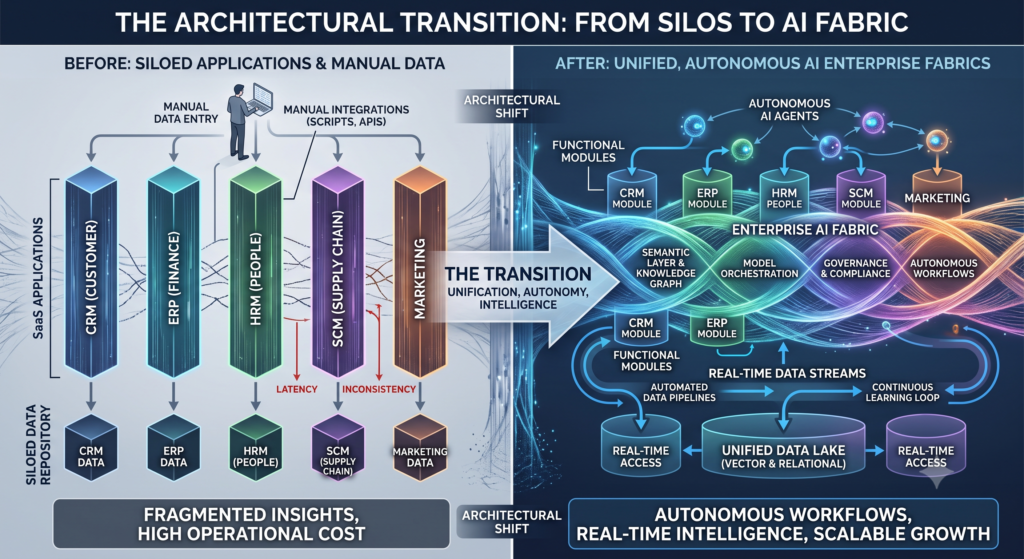
The era of AI experimentation in B2B enterprise technology is definitively over, replaced by an urgent mandate for architectural maturity, agentic workflows, and measurable operational ROI. For the past three years, business-to-business organizations operated like tourists in an artificial intelligence landscape, adopting disconnected copilots, experimenting with generative copywriting tools, and launching isolated chatbot pilots that rarely moved the needle on core revenue metrics. Today, the competitive battleground has shifted from surface-level novelty to structural integration. Enterprise leaders are no longer asking what artificial intelligence can generate; they are architecting how autonomous systems can execute complex, multi-stakeholder business processes with minimal human intervention.
This evolution represents the most significant structural reorganization of the enterprise software stack since the transition from on-premise servers to cloud computing. As we navigate a hyper-competitive B2B technology landscape, the companies dominating their sectors are treating AI not as an add-on feature, but as the foundational operating system of their enterprise. This shift requires a fundamental reassessment of technical architecture, data governance, revenue operations, and workforce competency.
The End of AI Tourism and the Rise of Architectural Maturity
For most of the early 2020s, enterprise AI strategy was characterized by fragmented investments and inflated expectations. Marketing teams purchased generative content tools, sales operations deployed email automation plugins, and IT departments tested isolated large language model (LLM) APIs. While these initiatives demonstrated incremental productivity gains, they frequently introduced massive technical debt, siloed data repositories, and critical security vulnerabilities.
We have entered a phase where enterprise technology priorities are defined by execution, operational constraints, and integration reality. According to industry benchmarks, while the vast majority of B2B organizations have incorporated AI into their long-term strategic roadmaps, only a small fraction feel confident that their underlying data foundations and security architectures are ready to support scalable deployment. This confidence gap stems from a simple technical truth: high-performing artificial intelligence requires pristine, well-governed data pipelines.
- Advertisement -
In the modern B2B ecosystem, software engineering itself is undergoing a paradigm shift from writing manual code to expressing business intent. Rather than engineering rigid, hardcoded workflows to handle supplier onboarding or enterprise billing, developers are deploying intelligent, modular applications that self-assemble and adapt based on real-time organizational needs. The competitive edge in B2B technology no longer hinges on how fast your engineering team can ship static software updates, but on how effectively your C-suite can orchestrate ecosystems of continuously learning models.
The Three Pillars of Modern B2B Tech Strategy
To build a resilient B2B technology organization capable of scaling throughout the decade, executive leadership must align resources around three foundational pillars: agentic automation, data governance, and cloud cost optimization.
Advancing Beyond Copilots to Autonomous Agentic Workflows
The most profound technological leap currently underway is the transition from assistive AI (copilots that suggest actions to human operators) to agentic systems capable of executing complex workflows autonomously. In a B2B context, an assistive copilot might draft a personalized sales outreach email or summarize a vendor contract. An agentic system, by contrast, monitors inventory thresholds across global supply chains, automatically identifies potential fulfillment bottlenecks, initiates Request for Proposal (RFP) evaluations with approved vendors, negotiates preliminary pricing parameters based on historical purchase data, and routes the finalized contract to legal representation for a single exception-based signature.
Industry projections indicate that by the end of the decade, the vast majority of routine B2B purchasing decisions will be intermediated by autonomous software agents. When a enterprise buyer’s procurement agent interacts directly with a vendor’s pricing and inventory agent, the traditional frictionless digital experience is replaced by machine-to-machine negotiation. Technology vendors that fail to build machine-readable trust signals, transparent API documentations, and dynamic pricing models will find themselves invisible to the automated purchasing systems of Fortune 500 enterprises.
Data Lineage and Governance as Core Intellectual Property
Artificial intelligence models are commodities; the proprietary enterprise data that fuels and refines them is the true differentiator. B2B leaders have learned through painful failed deployments that training advanced models on fragmented, inaccurate, or outdated customer records yields catastrophic results—often referred to in engineering circles as automated hallucination at enterprise scale.
- Advertisement -
Treating data governance as an afterthought is a recipe for operational failure. Today’s winning tech strategies treat data lineage, access control, and real-time streaming analytics as critical gating factors for AI adoption. Organizations are heavily investing in enterprise knowledge graphs that map the complex, multi-layered relationships between accounts, contracts, usage telemetry, and customer support tickets. By establishing zero-trust data architectures and strict lineage tracking, technology leaders ensure that autonomous agents operate within strictly defined operational boundaries without leaking sensitive IP across multi-tenant cloud environments.
Cloud 3.0 and FinOps Discipline
The computational demands of deploying domain-specific AI models have completely altered enterprise cloud economics. The era of unchecked public cloud expansion is over, replaced by a nuanced computing model often designated as Cloud 3.0. Because running continuous low-latency inference and fine-tuning proprietary models on public infrastructure can instantly erode profit margins, B2B organizations are aggressively adopting hybrid, multi-cloud, and sovereign cloud architectures.
This architectural shift has elevated FinOps (Financial Cloud Operations) from a specialized administrative accounting function to a primary technical discipline. Modern B2B engineering teams must build financial accountability directly into their deployment pipelines. Every model query, automated data transformation, and agentic workflow must be continuously evaluated against its financial yield. If the compute cost of running an autonomous lead-scoring agent exceeds the marginal revenue generated by the sales reps utilizing it, the system must be optimized, pruned, or re-architected to run on smaller, specialized, domain-specific models.
- Advertisement -
Reinventing the B2B Revenue Engine: Sales, Marketing, and Customer Operations
While IT infrastructure forms the bedrock of AI maturity, the most visible transformation is occurring across the B2B go-to-market (GTM) organization. The traditional B2B sales cycle—long, linear, and heavily dependent on intuition—is being systematically dismantled by predictive intelligence and automated execution.
Hyper-Personalization and Predictive Buyer Intent
Traditional B2B marketing relied on broad demographic segmentation and static lead-scoring models. Modern AI-driven revenue teams utilize continuous predictive modeling to map the entire enterprise buying committee before a prospect ever fills out a contact form. By ingesting massive volumes of unstructured data—such as third-party intent signals, content consumption patterns, website interaction telemetry, and historical CRM interactions—AI platforms can accurately identify when a target enterprise is actively experiencing an operational pain point.
Once high-intent accounts are identified, generative engines dynamically assemble personalized marketing collateral tailored to the specific industry, company size, and technical maturity of the prospect. Instead of sending a generic PDF whitepaper to a Chief Information Security Officer, AI workflows generate customized security architecture briefings that directly address the prospect’s public cloud footprint and compliance mandates.
The Paradox of Synthetic Saturation: The Demand for Human-First Media
As generative AI tools make it effortless to produce blog posts, emails, and technical documentation at infinite scale, B2B decision-makers are being inundated with synthetic content. An inbox flooded with grammatically flawless but intellectually hollow AI-generated sales pitches has triggered a massive shift in buyer psychology: an overwhelming demand for human-first, verifiable expertise.
In an ecosystem dominated by machine-generated noise, trust becomes the most valuable enterprise currency. B2B buyers are actively ignoring faceless corporate marketing in favor of authentic, identifiable voices, technical breakdowns from subject-matter experts, and unscripted executive commentary. The most successful B2B technology brands are using AI not to replace human thought leadership, but to amplify it—leveraging machine learning for backend research, data synthesis, and distribution optimization, while ensuring that the core insights, strategic opinions, and creative framing remain unmistakably human.
Orchestrating Frictionless Customer Onboarding and Success
In subscription-based B2B technology and SaaS business models, customer acquisition is merely the starting line; sustainable net dollar retention depends entirely on seamless onboarding and continuous value realization. AI systems are revolutionizing post-sale operations by autonomously analyzing real-time product usage telemetry to identify early indicators of customer churn.
When an AI monitoring agent detects that a newly onboarded enterprise account has experienced a drop in daily active users or has stumbled across a specific integration error code, it does not simply log a passive ticket. The system autonomously generates a customized technical remediation guide, alerts the assigned Customer Success Manager with contextualized account history, and proactively schedules a working session with the client’s engineering team. By transforming customer support from a reactive complaint-resolution center into a predictive, self-healing operational unit, B2B companies are drastically expanding their lifetime customer value.

Navigating the AI Confidence Gap and Workforce Evolution
Despite the extraordinary capabilities of modern AI systems, the single greatest point of failure in B2B technology transformations is rarely hardware or software—it is human capital. A pervasive skills gap threatens to stall enterprise AI momentum. While C-suite executives mandate rapid AI adoption across business units, operational teams frequently report feeling unequipped to integrate complex machine learning tools into their daily workflows.
This disconnect arises because traditional corporate training programs focus heavily on theoretical awareness rather than practical, role-specific competency. To bridge this divide, technology leaders must replace generic, one-size-fits-all AI seminars with hands-on, experiential learning frameworks.
- Embed AI Copilots Directly in Sandbox Environments: Enable engineering, sales, and procurement teams to experiment with autonomous tools within secure, mirrored corporate datasets where failure carries no financial or operational risk.
- Establish Cross-Functional AI Centers of Excellence: Build decentralized teams composed of data engineers, legal privacy compliance officers, and line-of-business managers who collaboratively review, authorize, and optimize new agentic workflows before they are deployed into production.
- Redefine Job Scorecards Around AI Orchestration: Shift performance metrics away from brute-force manual output and incentivize employees based on their ability to design, govern, and continuously refine automated, AI-assisted workflows.
An Actionable Blueprint for B2B Technology Leaders
For executives, product strategists, and IT decision-makers tasked with navigating this complex technological landscape, success requires abandoning fragmented pilot programs in favor of disciplined, structured execution. To capture genuine enterprise value over the next 12 to 24 months, technology leaders must execute four critical strategic imperatives:
- Conduct an Aggressive Data Lineage and Governance Audit: Before purchasing another LLM license or deploying a new autonomous agent, audit your enterprise data foundations. Eliminate data silos, establish clear metadata classification standards, and implement identity-centric zero-trust security architectures that ensure proprietary information cannot be compromised by automated systems.
- Target High-Friction, Repetitive Workflows for Agentic Autonomy: Identify the operational bottlenecks that drain human productivity across your organization. Focus early agentic AI deployments on highly structured, rule-bound processes—such as vendor invoice reconciliation, automated technical documentation generation, and multi-tier RFP analysis—where autonomous execution delivers immediate, measurable cost reductions.
- Institutionalize FinOps Governance Across All AI Initiatives: Treat computing capacity and inference costs with the same financial rigor applied to physical supply chain procurement. Mandate that every AI project plan includes detailed cost-per-query projections, cloud architecture optimization strategies, and clear criteria for decommissioning underperforming models.
- Prioritize Human-Centric Brand Building and Verifiable Trust: As your competitors flood the market with synthetic, automated marketing collateral, double down on visible human authorship, live technical demonstrations, and unscripted executive engagement. Utilize AI to optimize the backend mechanics of your business while preserving authentic human empathy and strategic expertise at every customer touchpoint.
The technological trajectory of the business-to-business landscape is unmistakable. We are moving rapidly toward an ecosystem of living, modular, and continuously learning enterprise software, where autonomous agents handle the friction of execution and human professionals provide the strategic intent. The organizations that thrive in this environment will not be those that simply deploy the most algorithms, but those that architect durable data foundations, enforce rigorous financial and operational governance, and empower their workforce to master the art of machine orchestration. The time for speculative experimentation has passed; the era of scalable AI execution has begun.