

Artificial intelligence is beginning to demonstrate its usefulness in places far beyond everyday productivity and software development. Two recent cases involving advanced AI models and World War II-era Enigma messages show how modern AI can assist researchers with historical cryptographic problems that have remained unresolved for decades.
The work is particularly notable because Alan Turing, one of the pioneers of modern computing, played a major role in breaking Germany’s Enigma communications during World War II. Today, AI systems are being used to revisit some of the messages that remained unsolved even after the war.
Revisiting the Enigma Challenge
During World War II, German forces used Enigma machines to encrypt military communications. British cryptanalysts, including Turing and his colleagues, developed specialized computing equipment known as the Bombe to help uncover the encryption settings needed to read intercepted messages.
Although many Enigma communications were eventually decoded, a small collection of messages remained unresolved. In several cases, researchers believe transcription mistakes or errors made by the original operators contributed to the difficulty.
- Advertisement -
Decades later, those historical puzzles are becoming test cases for modern AI reasoning systems.
OpenAI Model Helps Decode a Longstanding Mystery
Developer Carter Leffen recently asked OpenAI’s Astra model to investigate an unsolved Enigma message.
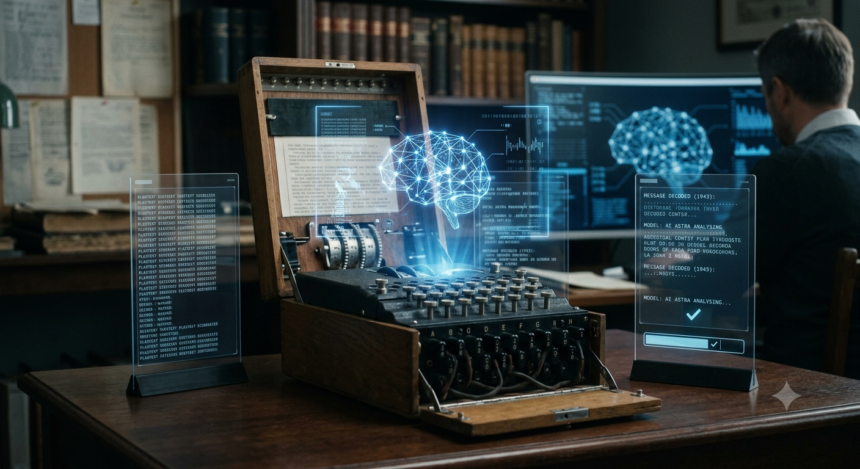
Rather than simply attempting a direct decryption, the model reportedly worked through multiple stages of research. It examined historical information, investigated contextual clues, constructed a simulation of an Enigma machine and used those findings to work toward a possible plaintext.
The message had reportedly remained unresolved since researchers began studying it in 2005.
Leffen also used the model to create an interactive website documenting the problem and the proposed solution, providing a way for others to examine the process.
- Advertisement -
Cryptology researcher Frode Weierud, who maintains the Crypto Cellar website and has spent years studying historical Enigma records, subsequently reviewed the work and validated the proposed solution.
Another Message Falls to Claude
A second breakthrough followed soon afterward.
Cryptanalyst Jack Willis reported using Anthropic’s Claude Opus 5 to solve another previously undecoded Enigma message. In this case, Willis provided the AI with more specific guidance, including information associated with the name of a particular German officer.
- Advertisement -
Using that contextual clue, Claude was able to work toward a solution for the message.
The two examples are different in how much human direction was involved, but both demonstrate how AI systems can combine historical research, pattern recognition and technical reasoning when working on complex problems.
What Makes These Results Interesting?
The significance is not simply that an AI model can perform mathematical calculations or imitate human conversation.
These investigations required several different capabilities. The models had to work with historical context, reason about encryption mechanisms, identify useful clues and connect information from different sources.
Weierud noted that the Astra investigation covered research that would traditionally require substantial time from a human researcher. He also raised questions about some of the archival references appearing in the model’s work, although it remains unclear exactly how those references became available to the system.
That uncertainty also highlights an important issue with AI-assisted research: understanding not only the answer produced by a model, but also how it reached that answer and which sources influenced the result.
The Enigma Puzzle Is Not Finished
Despite decades of research, a small number of Enigma messages reportedly remain unresolved.
According to Weierud, seven encrypted messages are still considered unbroken, along with another message for which researchers know the plaintext but have not fully recovered the encryption solution.
The recent results raise the possibility that AI systems could become useful research partners for historical cryptography and other difficult archival problems.
Rather than replacing specialist researchers, these systems may provide another set of tools for exploring problems that have resisted conventional approaches for years.
As AI reasoning capabilities continue to develop, some of history’s remaining cryptographic mysteries may become new experiments for testing what these systems can actually accomplish.