

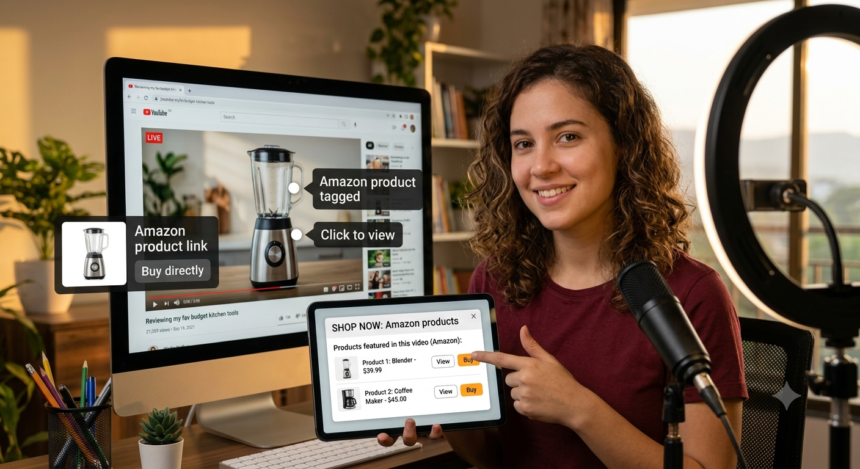
Creators can now tag Amazon products directly in Shorts, videos, and livestreams. The affiliate link finally has a native home.
On August 27, YouTube confirmed that Amazon has joined its Shopping Affiliate Program. Eligible creators in the United States can now attach Amazon products to their content — Shorts, long-form uploads, and live broadcasts alike — and collect a commission when viewers buy.
Travis Katz, who runs Shopping at YouTube, framed it around trust: viewers already take buying cues from the creators they follow, so the purchase path should sit where the recommendation happens, not three scrolls down in a description box.
That is the real change here. YouTube has had affiliate shopping for a while, with participating retailers plugged in. What it lacked was Amazon’s inventory — arguably the default catalog for anything a viewer might want to buy after watching a review, an unboxing, or a kitchen demo. Adding it turns a workaround into a workflow.
- Advertisement -
What actually changes for creators
The link moves into the frame. Until now, the Amazon Associates route meant pasting a link into the description and hoping the viewer scrolled, tapped, and converted before the impulse faded. Tagged products surface in the viewing surface itself, which removes several steps from an already leaky funnel.
A curated catalog, not the whole warehouse. Creators pick from a selection Amazon supplies, weighted toward trending and in-demand items. If something you want isn’t in the picker, you can send the product URL to YouTube Creator Support and request it.
Auto-tagging is on the table. With the setting enabled, YouTube can scan recent uploads, spot eligible Amazon products, and tag them without the creator doing anything. Back catalogs suddenly become live inventory — which is either a windfall or a reason to audit what your old videos are now selling on your behalf.
Analytics stay coarse. Studio shows aggregate daily revenue, clicks, and sales. It does not show which video or which product drove a purchase. For anyone used to running attribution on affiliate performance, that is a meaningful blind spot — you’ll know the channel is earning, not which content is earning.
Money lands through AdSense, on a lag. Commissions lock monthly and pay out through the existing affiliate payment cycle. YouTube’s own example: earnings that lock in January arrive in the March AdSense cycle. Returns claw back against your current balance, and a negative month rolls forward until earnings turn positive again.
- Advertisement -
Tags travel, even if eligibility doesn’t. Only U.S. creators can tag for now, but the tags are visible worldwide. YouTube says it may match a tagged product to a trusted local merchant so international purchases still earn. Where no local match exists, the tag routes to the Amazon U.S. storefront.
Eligibility, in one breath
You need to be in the YouTube Partner Program, enrolled in the U.S. Shopping Affiliate Program, hold an active Amazon Influencer or Associates account in good standing, and have that account linked to your channel. One caveat worth flagging: only one YouTube channel per Amazon account qualifies, and anyone who linked before September 2024 has to re-link.
Why this matters beyond the creator economy
For Amazon: distribution without acquisition. Amazon doesn’t need to build a video platform when it can sit inside the one people already watch for purchase research. Every product review on YouTube becomes a potential storefront.
- Advertisement -
For YouTube: a second revenue engine that doesn’t depend on ad load. Commerce revenue scales with intent rather than impressions, and it gives creators a reason to stay inside the ecosystem rather than routing audiences to newsletters, Linktrees, or Amazon storefronts of their own.
For brands and marketers: the calculus on creator partnerships shifts. If a creator can monetize a mention natively, the value of a flat-fee sponsorship gets compared against what organic tagging would have earned anyway. Expect more hybrid deals — smaller upfront fees, performance upside — and expect commerce-heavy formats (hauls, comparisons, “what’s in my bag”) to get more competitive as the earnings math improves.
The friction that remains: without per-video attribution, neither creators nor the brands working with them can cleanly prove which content converted. That gap will shape how these partnerships get priced until YouTube closes it.
What to do this week
- If you’re a creator: confirm your Amazon Influencer or Associates link is current, then decide deliberately on auto-tagging before it decides for you.
- If you run influencer marketing: revisit your rate cards. A creator with tagging enabled has a new baseline earning floor, and your negotiation position changes with it.
- If you sell on Amazon: creator content is now a demand channel with a native conversion path. Seeding product to relevant channels just got a clearer return.