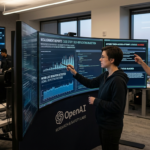



As AI agents become more capable of operating independently, controlling their actions has become one of the industry’s most important challenges. Nvidia recently launched a broad industry initiative aimed at preventing AI agents from behaving outside their intended boundaries. Yet one major AI company was noticeably missing from the public list of supporters: OpenAI.
Nvidia’s Open Agent Safety Platform brings together more than 100 companies and organizations around technologies designed to monitor and control autonomous AI agents. Companies such as Anthropic have publicly backed the initiative, while several major technology players, including Amazon, Google, and Apple, have not formally joined.
OpenAI’s absence initially raised questions, particularly given the company’s prominent role in developing agent-based AI systems. However, OpenAI has indicated that it supports Nvidia’s work and is already collaborating with the chipmaker on agent security technology.
A Different Approach to Controlling AI Agents
At the center of Nvidia’s platform is OpenShell, an open-source technology designed to place AI agents inside controlled environments. The goal is to prevent an agent from escaping its assigned boundaries or accessing systems and resources beyond its permissions.
- Advertisement -
The technology has gained additional attention following incidents involving autonomous AI systems. Hugging Face CEO Clem Delangue suggested that stronger agent monitoring could potentially have detected suspicious activity during an incident involving OpenAI-powered agents before the company identified it independently.
Hugging Face has also contributed technology to Nvidia’s platform that can identify situations where an AI agent technically has access to a website or service but uses that access in an unauthorized manner.
This type of monitoring could become increasingly important as AI agents begin handling more complex tasks across software platforms, repositories, and enterprise systems.
Nvidia’s Hardware Gives the Platform Another Dimension
Nvidia’s approach extends beyond software-based sandboxing. Its system also includes a hardware security component called Nvidia Sentry, which operates through the company’s BlueField-4 data processing units.
The concept is to monitor agent activity at the hardware level and provide the ability to stop an agent when its behavior violates defined controls. Nvidia argues that this layer can make monitoring more difficult for an AI system to detect or circumvent.
- Advertisement -
However, the hardware component also creates an important distinction between Nvidia’s platform and a completely open-source security system. While OpenShell can potentially be adapted for different hardware, Nvidia’s full security architecture relies on proprietary technology designed around Nvidia processors.
Companies including Arm and Intel have nevertheless supported the initiative, partly because the software components can be adapted to other hardware environments.
Why OpenAI May Be Keeping Its Options Open
OpenAI’s decision not to publicly join Nvidia’s consortium may reflect its broader strategy around AI security. The company is developing its own safeguards and has been increasing its focus on cybersecurity as a commercial opportunity.
- Advertisement -
OpenAI also operates the Defense Factory, a cybersecurity collaboration designed to facilitate information sharing across the industry. The initiative has attracted organizations that have not publicly committed to Nvidia’s technology-focused platform.
This creates two complementary approaches within the AI industry. Nvidia is attempting to establish a shared technical infrastructure for controlling autonomous agents, while OpenAI is developing its own security systems and partnerships.
For businesses adopting AI agents, the broader development is significant. Security is moving beyond traditional application controls toward continuous monitoring of what autonomous systems actually do.
As agents receive greater access to corporate systems, data, websites, and software tools, companies will need safeguards that can detect unusual behavior, enforce boundaries, and intervene when necessary.
The competition between different approaches may ultimately produce a wider range of tools for securing autonomous AI. For now, OpenAI’s support for Nvidia’s technology, despite its absence from the public consortium, suggests that collaboration and competition are both shaping the next generation of AI security.