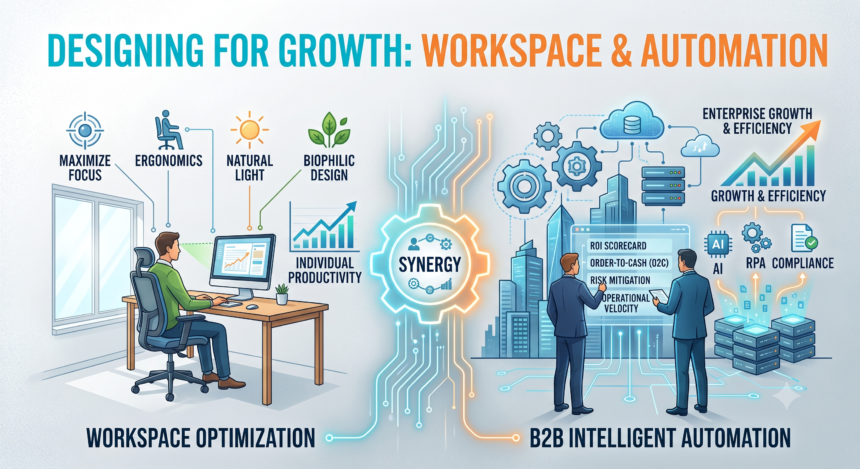
In an era defined by economic volatility, shifting supply chain dynamics, and accelerating digital transformation, modern enterprise leaders face a sharp ultimatum: scale efficiently or risk irrelevance.
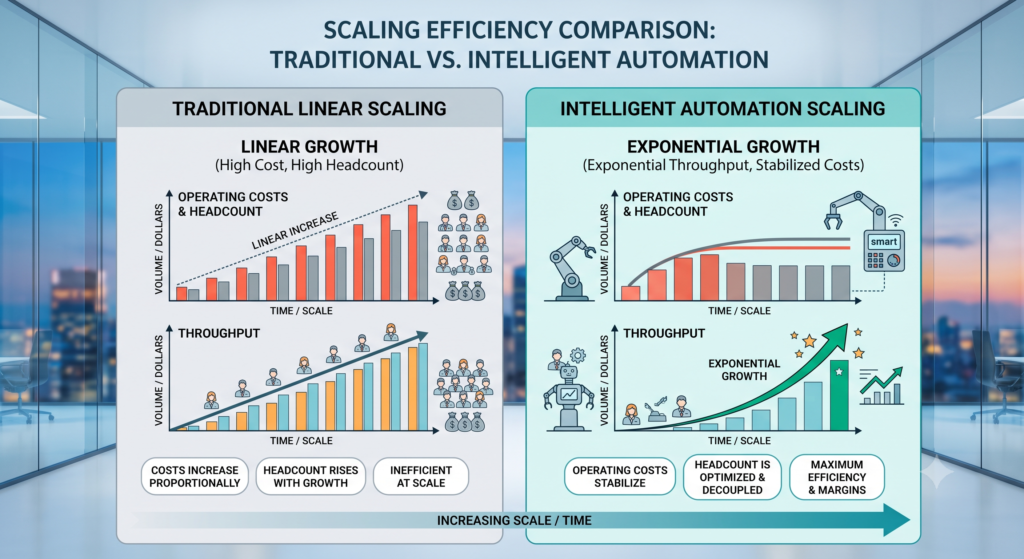
For years, the standard playbook for enterprise growth was straightforward: as revenue grew, companies scaled headcount proportionally to manage increasing operational complexity. Today, that linear model is broken. Skyrocketing labor costs, skill shortages, and fragmented software stacks mean that simply throwing more human hours at operational friction is a recipe for margin erosion.
Enter Intelligent Automation (IA)—the convergence of Robotic Process Automation (RPA), Artificial Intelligence (AI), and Business Process Management (BPM).
When executed strategically, IA transforms back-office cost centers into high-speed growth engines. However, despite massive hype, many C-suite executives struggle to bridge the gap between initial pilot projects and enterprise-wide return on investment (ROI).
- Advertisement -
This guide breaks down how B2B organizations can move beyond basic task automation, design an agile operational architecture, and realize measurable financial value from intelligent automation.
1. Beyond Cost Reduction: Redefining Automation Value in B2B
When business leaders evaluate new technologies, the initial pitch almost always focuses on cost avoidance: “This software will save X thousand hours of manual labor per year.”
While labor efficiency is a tangible metric, treating automation strictly as a cost-cutting tool severely undervalues its strategic potential. In B2B environments—where sales cycles are long, contract values are high, and client relationships are high-stakes—the true ROI of automation manifests across three primary pillars:
A. Accelerated Velocity to Revenue
Manual processes slow down the cash-to-cash cycle. Consider the average enterprise B2B sales flow: contract negotiation, credit checks, vendor onboarding, order processing, and invoicing. If manual handoffs introduce delays at every junction, your time-to-revenue stretches from days to weeks. Automated workflows eliminate lag, allowing revenue recognition to happen faster and cash flow to remain predictably predictable.
B. Risk Mitigation and Compliance
Human error in manual data entry isn’t just an inconvenience; in regulated industries like finance, healthcare, and logistics, it is a liability. A single miskeyed digit in a B2B procurement contract or tax filing can trigger costly compliance fines, delayed shipments, or breach-of-contract litigation. Automated systems execute rule-based tasks with 100% precision, generating audit-ready compliance logs automatically.
- Advertisement -
C. Enterprise Agility and Employee Retention
Your top talent did not get advanced degrees or decades of industry expertise to spend 15 hours a week copying data between legacy ERPs and modern CRMs. Repetitive admin work breeds burnout and turnover. By automating mundane tasks, you elevate your staff’s everyday responsibilities to high-value strategic initiatives—improving employee satisfaction while driving innovation.
2. Uncovering the Hidden Friction in B2B Workflows
Where should an enterprise begin its automation journey? The biggest mistake organizations make is automating broken or inefficient processes without re-engineering them first. Automating a chaotic process simply yields faster chaos.
To identify the highest-value automation candidates, operational leaders should audit their business functions using a simple 2×2 assessment matrix: Volume vs. Complexity.
- Advertisement -
Process Category
Characteristics
Automation Strategy
High Volume, Low Complexity
Standardized, rules-based, predictable (e.g., invoice data entry, system syncing).
Immediate RPA Deployment: Quick wins with rapid, quantifiable ROI.
Human-in-the-Loop (HITL): Augment decision-makers with predictive AI insights.
Case Study Focus: The Order-to-Cash (O2C) Bottleneck
Consider a mid-market industrial manufacturer processing thousands of custom purchase orders annually. Traditionally, customer service reps received PDFs via email, manually verified line items against inventory systems, re-keyed order details into SAP, and generated invoices.
By implementing Optical Character Recognition (OCR) powered by natural language processing (NLP), incoming orders are automatically read, verified, and pushed into the ERP in seconds. Human intervention is required only when the system flags an anomaly—such as an unexpected price mismatch or missing part number.
The result? Processing time per order drops from 25 minutes to under 90 seconds, while order accuracy climbs past 99.5%.
3. Designing a Governance Framework That Scales
A common failure mode in B2B tech transformations is the emergence of “shadow automation”—fragmented, localized scripts built by siloed teams without IT oversight or security governance.
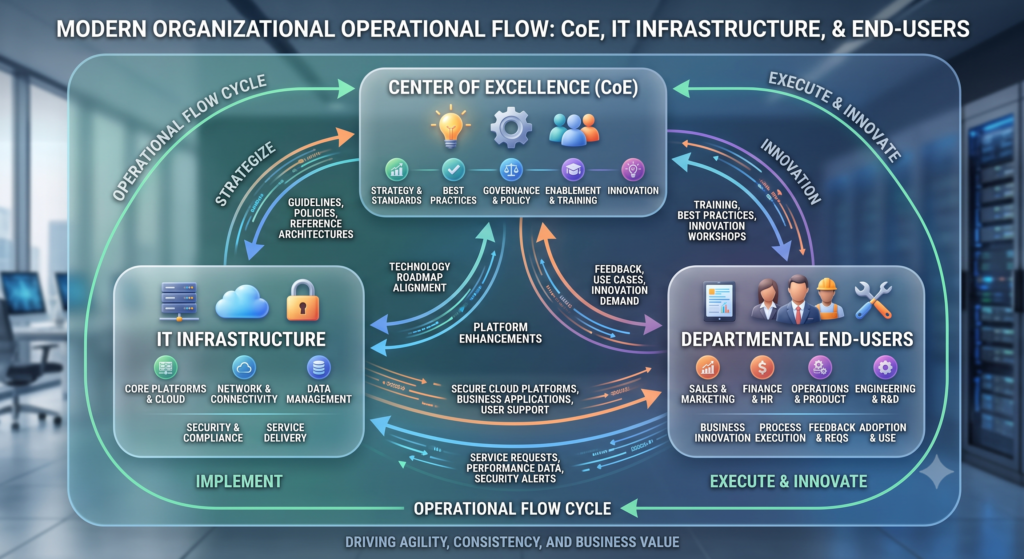
To build an enterprise-grade automation engine that scales safely, executive teams must establish a Center of Excellence (CoE).
Key Roles within an Automation Center of Excellence:
The Executive Sponsor: A C-level champion (COO, CIO, or CFO) who aligns automation goals with overall enterprise strategy and secures funding.
The Lead Automation Architect: Responsible for technical infrastructure, vendor security compliance, and ensuring new tools integrate smoothly into legacy stacks.
Process Analysts: Business-side specialists who shadow teams, map workflows, and quantify potential ROI before a single line of code or script is written.
Change Champions: Departmental leaders who manage training, address employee hesitation, and encourage adoption across frontline teams.
Key Takeaway: A CoE ensures that every automation project undergoes rigorous ROI qualification, security vetting, and maintenance protocols, preventing technical debt from accumulating down the road.
4. Measuring What Matters: Building Your ROI Scorecard
To justify ongoing investment in Intelligent Automation, business leaders must track and communicate metrics that speak directly to the board and financial stakeholders. Moving beyond simple “hours saved,” your automation scorecard should measure:
1. Hard Cost Metrics
FTE Reallocation Value: The dollar value of human capacity freed up and redirected to revenue-generating or strategic initiatives.
Error Reduction Savings: Direct cost savings from eliminating rework, late payment penalties, and compliance audits.
Software License Consolidation: Reduced overhead by retiring redundant legacy single-use tools in favor of unified orchestration platforms.
2. Operational Metrics
Cycle Time Reduction: The percentage decrease in end-to-end processing time (e.g., reducing vendor onboarding from 10 days to 4 hours).
Throughput Capacity: The ability to handle scaling transaction volume without increasing headcount during peak seasons.
3. Human & Customer Metrics
Net Promoter Score (NPS) Impact: Faster response times and fewer operational errors lead directly to higher customer retention in B2B environments.
Employee Retention Rates: Tracking turnover reductions in departments that have transitioned away from monotonous manual data entry.
Conclusion: The Path Forward for Modern B2B Enterprises
Intelligent Automation is no longer an experimental initiative reserved for tech giants with limitless budgets; it has become an operational necessity for any B2B enterprise looking to defend margins and capture market share.
The organizations that win over the next decade won’t necessarily be those with the largest teams, but those with the smartest operational architectures. By treating automation as a core strategic discipline—guided by clear ROI frameworks, strong governance, and human-centric process design—you build a resilient business ready to scale through any market condition.
Next Steps for Operational Leaders:
Audit Your Top 5 Pain Points: Identify the five most manual, repetitive workflows currently slowing down your operational output.
Calculate Your Baseline: Map out the exact human hours, error rates, and cycle times associated with those processes today.
Engage Key Stakeholders: Bring together operations, IT, and finance to define a shared vision for pilot projects with clear, quantifiable metrics for success.