


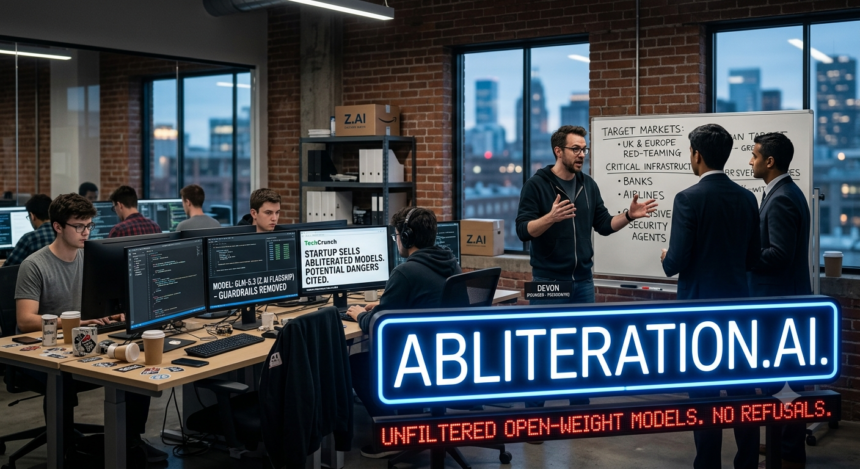
A startup is now selling hosted access to open-weight models with their refusal behaviour surgically removed. The technique is four years old and freely published — what changed is that someone put a credit card form in front of it.
The news
Abliteration.ai, incorporated in March and operating on customer revenue rather than venture funding, hosts modified builds of open-weight models with their safety refusals stripped out. Users reach them through a browser or an API. Among the models on offer is GLM-5.3, the Chinese lab Z.ai’s flagship release from August.
TechCrunch reported this week that it registered a free account and, in short order, got the modified model to produce both working credential-theft code and a home protocol for culturing a dangerous pathogen. The company’s own pitch, posted publicly, frames the service as infrastructure for offensive security and agent testing that mainstream models decline to support.
The founder, who goes by Devon publicly because he still holds another job, says the customer base is mostly early-stage red-teaming firms in the UK and Europe working with banks, airlines and critical infrastructure operators.
- Advertisement -
What is actually new here — and what isn’t
The technique is not new, and that matters for how you read the story.
In 2024, Andy Arditi and co-authors published Refusal in Language Models Is Mediated by a Single Direction at NeurIPS. The finding: a model’s decision to refuse is largely carried by one direction in its activation space, identifiable by comparing what the model does on harmful versus harmless prompts. Remove the model’s ability to represent that direction and the refusal behaviour goes with it. The community named the procedure “abliteration” — ablation plus obliteration — and Hugging Face now hosts thousands of pre-abliterated checkpoints alongside off-the-shelf tooling to produce more.
So the capability has been sitting in public since 2024. Three things changed:
- The base model got good. Z.ai’s GLM-5.3 is a roughly 750-billion-parameter mixture-of-experts model with a million-token context, pitched explicitly at agentic coding and cyber work. Z.ai reports Terminal-Bench 3.0 jumping from 4.6% to 28.3% over the prior version, achieved through post-training alone. Abliterating a weak model was a curiosity. Abliterating this one is a different proposition.
- The friction went to zero. Even the aggressively quantised builds of GLM-5.3 need hundreds of gigabytes of memory. Hosting it removes the hardware barrier entirely — no download, no GPU procurement, no ops.
- It became a company. With cloud contracts, revenue, and VC conversations underway, an underground practice acquired a billing relationship and a support queue.
The defender’s case, and where it wobbles
The argument for the service is the standard security one: you cannot defend against what you cannot reproduce, and attackers are already doing this for free. Devon extends it further, arguing that putting these tools in defenders’ hands accelerates cybersecurity rather than degrading it.
Several red-teaming practitioners quoted in the reporting agree with the premise and dispute the conclusion. Fabraix’s CEO says his firm gets what it needs by fine-tuning open models, which arrive with thin guardrails anyway, and notes that abliteration strips out capability along with refusal. Armadin’s founder was blunter: open-weight models up to the current generation were easy enough to jailbreak that abliteration never entered the workflow.
- Advertisement -
That capability-loss objection is measurable, not rhetorical. A comparative study of abliteration tooling across sixteen instruction-tuned models found real trade-offs between refusal removal and benchmark preservation depending on method. Which sets up an awkward position for the vendor: the more thoroughly you abliterate, the more you damage the thing customers are paying for.
The research has also moved past the clean single-direction story. Work published this year finds refusal behaviours spread across geometrically distinct directions, and defensive techniques are arriving — extended-refusal fine-tuning reportedly holds refusal rates above 90% after a standard abliteration attempt, and refusal aliasing targets the extraction step itself. Abliteration is a live arms race, not a settled capability.
The KYC hole
The most exposed part of the operation is not the technology. Abliteration.ai offers customers an optional moderation layer they can configure themselves, and the platform carries a few residual blocks. But identity verification amounts to logging the payment card. Devon’s own framing of the problem — where a company’s responsibility begins and ends — is candid, and unresolved.
- Advertisement -
CivAI research head Andrew Yoon, who has argued in the Wall Street Journal that open-weight models are becoming a national security question, put it in harsher terms: abliteration lets you <q>modify the model so that it becomes a sociopath</q>. His proposed interventions target the layer below the model — mandatory harm classifiers at providers, and identity verification at companies renting advanced GPU access.
The regulatory blind spot worth watching
Here is the part most coverage misses. Under the European Commission’s GPAI guidance, a downstream modifier becomes a provider — inheriting the obligations — when its modification significantly changes a model’s generality, capabilities or systemic risk. The headline indicative criterion for that threshold is training compute: roughly one-third of the original model’s compute, or 3⅓ × 10²² FLOP where the original is unknown.
Abliteration is a weight edit derived from a small set of contrastive prompts. It is computationally trivial. On the compute indicator alone, removing a frontier model’s safety behaviour sits nowhere near the line that removing far less consequential capability constraints would cross. The materiality test is broader than the compute figure — a modification to a systemic-risk model can pull full systemic-risk obligations — but the guidance was built with fine-tuning in mind, and abliteration is the case where cost and consequence come apart completely.
Commission enforcement powers for GPAI models took effect in August 2026. This is a live question, not a theoretical one.
What this means if you’re buying or building
- Vendor diligence needs a new question. If you procure red-teaming or agent-security services, ask what models sit in the testing stack, where they are hosted, and what leaves your environment. “We use uncensored models” is now a supply-chain answer, not a technical footnote.
- Open-weight adoption carries a modification story. If your organisation touches open weights in a regulated European context, the provider-flip risk is worth pricing before model selection, not after.
- Safety posture is becoming a model-selection criterion. Model cards that document robustness to representation-level attacks — not just refusal rates out of the box — will start mattering to enterprise buyers.
The underlying question the industry has not answered: if safeguards can be removed by anyone with the weights and a modest amount of compute, does hosting the result make the internet safer or simply faster to attack? Both sides of that argument are currently being made by people with commercial interests in the answer.