


If your team has spent the past year obsessing over “getting cited by ChatGPT,” a new industry study suggests you may be optimizing for the wrong front door.
AI discovery agency Previsible has released the third edition of its AI Traffic Study, and the topline finding cuts against a lot of the current GEO (generative engine optimization) narrative: Google remains the main surface for AI-influenced brand discovery, even as ChatGPT dominates measurable referrals from standalone AI assistants.
For B2B marketers running content and demand programs, that distinction matters. It’s the difference between building for visibility inside Google’s AI layer versus optimizing purely for referral clicks from a chat interface — and the study suggests most brands need to do both, in a specific order.
What the Study Actually Measured
The report covers data from November 2024 to May 2026 and analyses 6.77 million LLM-driven sessions across 166 websites. It’s based on 166 Google Analytics 4 properties and measures referral traffic from standalone LLM platforms, spanning industries including SaaS, e-commerce, finance, legal, health, insurance, education, publishing, and ticketing.
- Advertisement -
One important methodology note: Google AI Overviews were excluded from the standalone LLM dataset, since Google’s AI search features operate under a different measurement model and don’t produce trackable referral sessions the same way standalone assistants do. So when Previsible says Google “leads,” that’s a separate, broader claim — not something pulled from the same referral-tracking dataset as the ChatGPT numbers.
Google Leads Overall — Standalone Assistants Are the Fast-Growing Niche
AI discovery inside Google — including AI Overviews and AI Mode — represents a larger volume of AI-influenced traffic than standalone LLM platforms combined. Previsible’s own recommendation follows from that: Google’s AI Overviews and AI Mode are the surfaces marketers should prioritize through the second half of 2026.
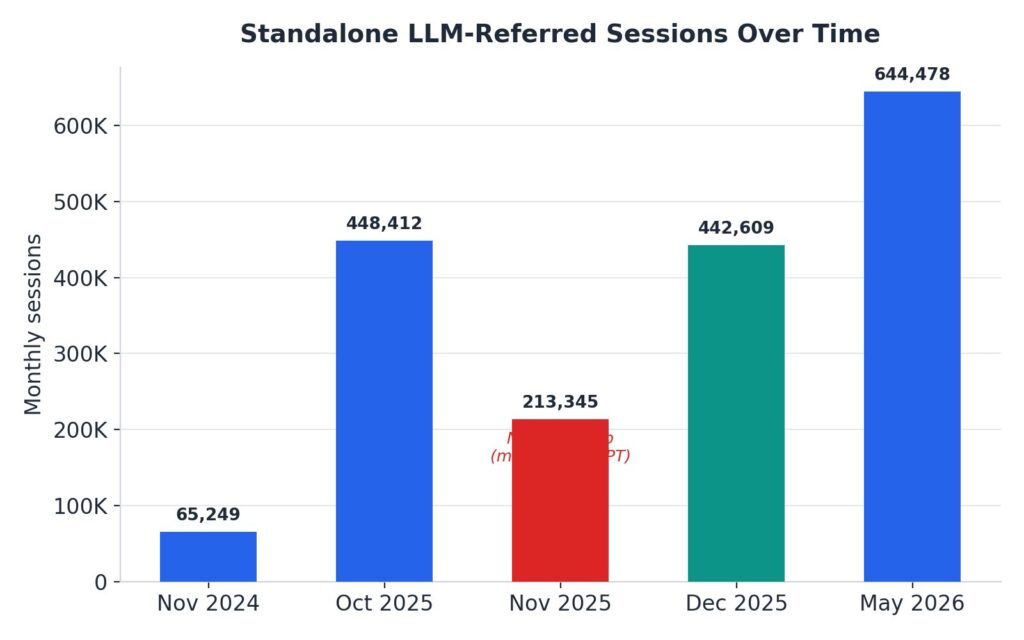
That said, the standalone assistant channel is growing fast in absolute terms. Total monthly standalone LLM-referred sessions grew 9.9 times between November 2024 and May 2026, climbing from 65,249 sessions in November 2024 to 644,478 in May 2026.
Growth wasn’t linear, though. Monthly standalone referrals fell 50% in November 2025, driven mainly by a drop in ChatGPT referrals — from 448,412 sessions in October 2025 to 213,345 in November — before recovering to 442,609 by December. Previsible did not attribute the dip to a single confirmed cause, which is worth flagging to clients or leadership if they ask about a single month’s traffic dip: it may be platform-wide noise, not a signal about your content.
ChatGPT Still Dominates the Standalone Channel
- Advertisement -
Within the standalone assistant category, the hierarchy is not close. ChatGPT accounted for 92.4% of standalone AI referral traffic across the sites analysed, up from roughly 84% in Previsible’s prior report. At that earlier point, Perplexity held 8.9%, Gemini 4.5%, Copilot 2.1%, and Claude 0.6%.
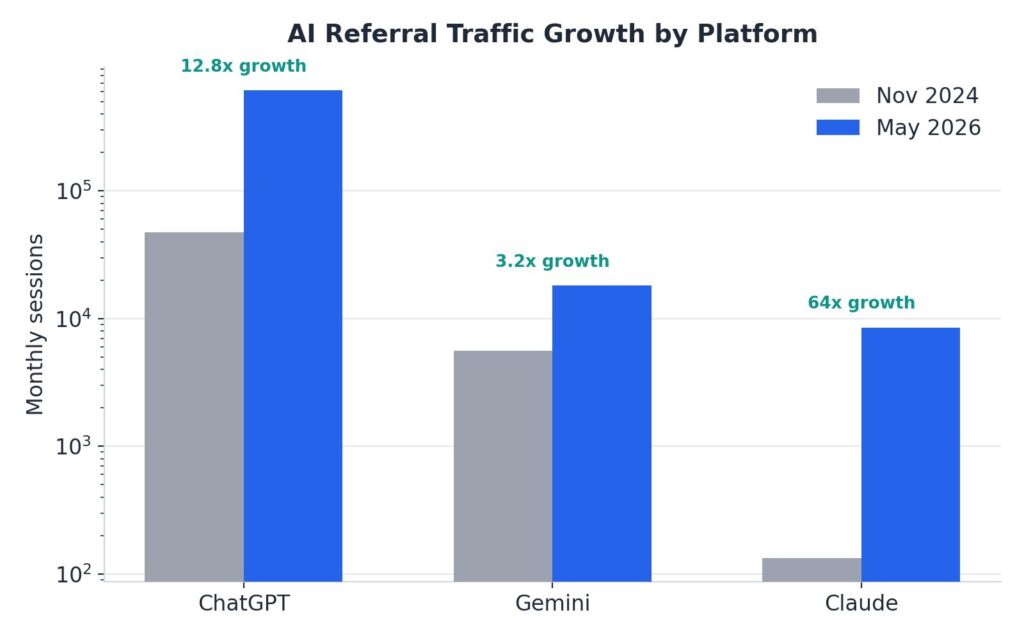
ChatGPT’s own referral traffic rose from 47,606 sessions in November 2024 to 610,910 in May 2026 — a 12.8x increase over 19 months.
A few other platform trends worth noting for anyone building a multi-platform GEO strategy:
- Advertisement -
- Gemini grew 3.2x and became the second most visible model behind ChatGPT, rising from 5,598 sessions to 18,119.
- Claude grew 64x over the study period — from 133 sessions to 8,528 — and overtook Perplexity in monthly referral volume in March 2026, holding that position through May.
- Claude’s referral traffic skewed toward developers, technical buyers, and professional services audiences.
- Perplexity peaked at 17,507 monthly sessions in March 2025 before falling to 6,788 by May 2026, and Copilot dropped from 8,651 sessions in August 2025 to just 339 in May 2026.
For agencies advising B2B SaaS or professional services clients, the Claude data point is a small but real signal: if your buyer persona is technical, Claude-referred traffic — while tiny in absolute volume — may be disproportionately qualified.
AI Traffic Impact Varies Sharply by Industry
This is the section most relevant to campaign planning. AI referral traffic to e-commerce content rose 37x, with product pages becoming the primary landing surface for e-commerce LLM traffic.
Insurance saw AI traffic penetration rise 18.9x to 1.51% of total sessions, education grew 5.4x, and finance increased from 0.56% to 1.19% of sessions. SMB websites rose from 0.4% to 1.71%.
Notably, health was the only vertical where AI traffic penetration actually declined, dropping from 0.23% to 0.17%.
Page-type behavior also differs meaningfully by industry — a detail that matters for content briefs and internal linking strategy:
- In SaaS, internal search pages accounted for 34.6% of LLM referrals.
- In education, course pages accounted for 52% of LLM referrals.
- In publishing, news pages accounted for 54% of referrals, though LLM penetration stayed low at 0.08% against over 120 million organic sessions.
- In health, “about” pages captured 42.1% of LLM referrals — likely users verifying source credibility after being pointed there by an AI assistant.
- In legal, referrals spread more evenly across blog, about, contact, and location pages.
- In financial services, blog content captured the largest share of LLM referrals, and some conversion pages — enrollment, sign-up, product-entry — recorded LLM-to-total traffic ratios above 2%.
- Across all industries studied, roughly 25% of AI-referred traffic landed on internal search results pages.
What Previsible Recommends for H2 2026
David Bell, Previsible’s chief product officer and the report’s author, framed the priority order clearly: the foundation brands built in search matters more than ever, and the sequence should be to first become a source Google’s AI results want to cite — building the site architecture and content signals AI systems rely on — then focus on winning ChatGPT as the leading standalone surface.
The report recommends five areas of focus: building citation-worthy evidence, improving authority across trusted third-party sources, making websites easier for AI systems to read and extract, optimizing for answer journeys, and measuring business impact rather than broad visibility alone. It also urges marketers to measure AI traffic by page type rather than relying on site-wide averages, since pricing, product, course, and conversion pages all behave differently.
Previsible CEO Jordan Koene added a useful reframe for how to think about this traffic in the first place: the research highlights an often-overlooked part of AI search — the value of engaged users who actually visit and interact with brand websites after arriving via AI-driven discovery. That’s a good reminder not to chase AI citations for their own sake, but to track what those visitors do once they land.
The Takeaway for B2B Marketing Teams
AI-referred traffic is still a small slice of total sessions for most sites in this dataset — but it’s growing fast, unevenly across industries, and landing on different page types depending on vertical. The practical playbook this data points to:
- Fix the foundation first. Site architecture and content clarity for Google’s AI Overviews and AI Mode still carry the most volume.
- Then build ChatGPT-specific citation content, since it captures the overwhelming majority of standalone referral traffic.
- Don’t ignore Claude if your buyer is technical — its referral quality profile skews toward developers and professional services audiences even though volume is small.
- Audit by page type, not site average. Where AI traffic lands — internal search, product pages, about pages, blog content — differs by industry, and your content investment should follow the pattern that matches your vertical.