

By using this site, you agree to the Privacy Policy.
Accept
Content LeadContent Lead
  • Home
  • Latest News
  • Technology
  • Business
  • Marketing
  • White Paper
  • Event
  • Contact Us
Reading: AI Personalization in B2B: The 5 Triggers That Actually Convert in 2025
Share
Aa
Content LeadContent Lead
Aa
Search
  • Home
  • Latest News
  • Technology
  • Business
  • Marketing
  • White Paper
  • Event
  • Contact Us
Follow US
© 2024 - All Right Reserved by Content Lead
- Advertisement -
Home » Blog » AI Personalization in B2B: The 5 Triggers That Actually Convert in 2025
Artificial IntelligenceB2BTechnology

AI Personalization in B2B: The 5 Triggers That Actually Convert in 2025

Sunil Panchori
Sunil Panchori
Share
4 Min Read
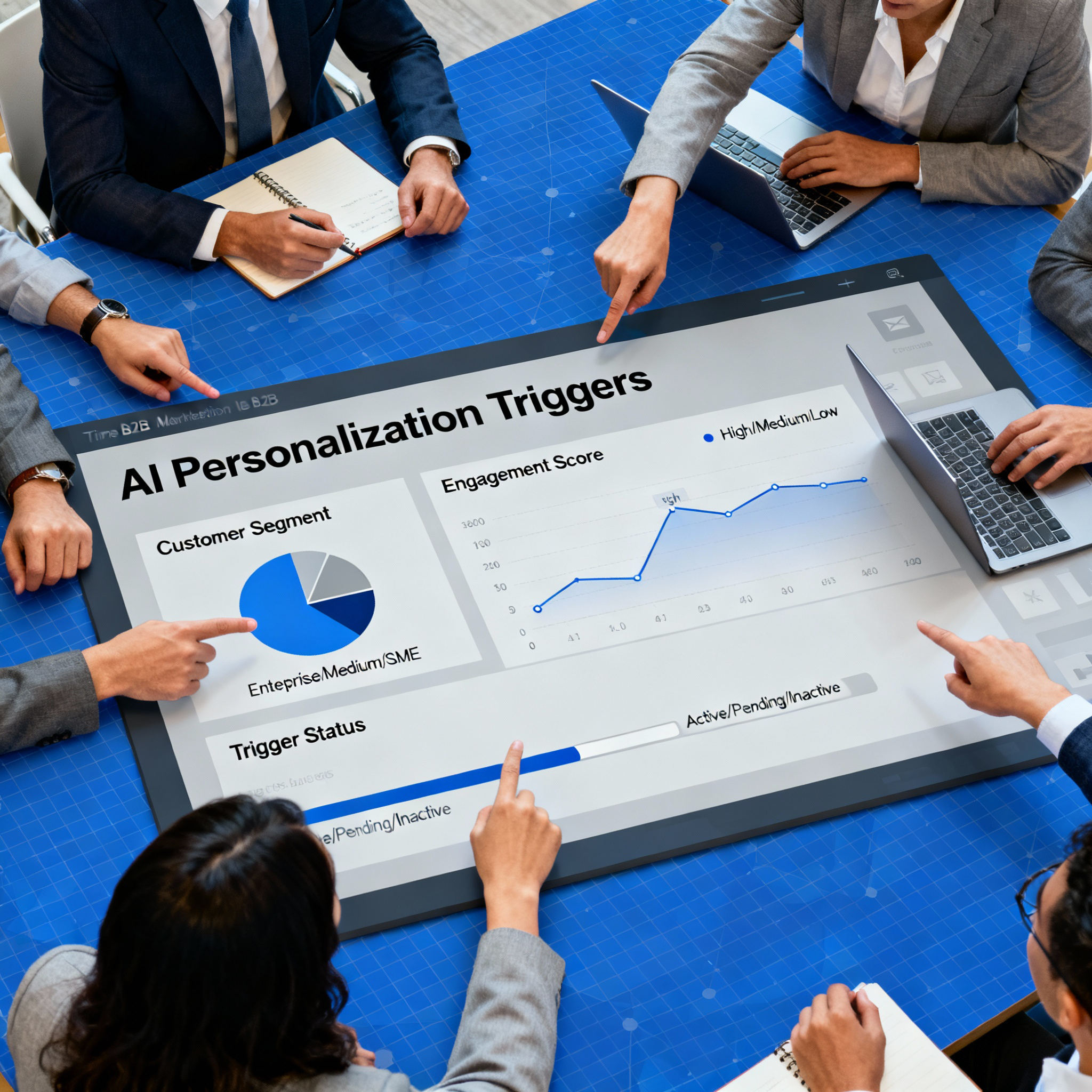
AI-driven personalization is now essential as B2B buyers demand relevant, real-time interactions tailored to their needs and stage in the journey. Buyers are no longer satisfied with generic messages or untargeted outreach; they expect dynamic, one-to-one experiences across every channel.
1. Multi-Visit Pricing Page Engagement
  • What it signals: Repeated visits to pricing or plan comparison pages indicate strong, late-stage buying intent and readiness for deeper discussions.
  • Activation: Trigger an industry-tailored pricing breakdown or ROI calculator. Enable instant calendar booking with an account executive, and follow up via email with a customized summary.
  • Why it works: Capitalizes on high-intent moments and helps convert window shoppers into qualified opportunities.
2. Return Visits to Solution/Integration Content
  • What it signals: Buyers who regularly revisit solutions pages, integration documentation, or compliance resources are evaluating technical fit and readiness to shortlist your offering.
  • Activation: Swap website banners and CTAs based on observed interests (e.g., showcase case studies from the buyer’s industry), and trigger a personalized invitation to a relevant demo or sandbox.
3. Account-Level Intent Surges
  • What it signals: Intent signals at the account level—such as multiple stakeholders researching your brand, spikes in third-party site visits, or targeted ad engagement—highlight buying group mobilization.
  • Activation: Launch account-based marketing (ABM) sequences, custom landing pages based on segment and role, and orchestrate targeted sales follow-up with personalized assets.
4. Product Usage or Proof-of-Concept Milestones
  • What it signals: A prospect achieving key POC or trial milestones (e.g., activating new features, integrating with core systems) often indicates the tipping point for successful conversion or expansion.
  • Activation: Deploy success-driven messaging, in-app guides, and offer account manager check-ins precisely when these milestones are hit, reinforcing value realization and minimizing drop-off.
5. Event and Asset Engagement Spikes
  • What it signals: Intense engagement—such as attending a webinar, downloading multiple assets, or revisiting thought leadership content in a short window—shows topical urgency and collective interest from the buyer’s team.
  • Activation: Automatically trigger tailored follow-up: recap emails, fast-track demo invitations, and content streams that align with the asset theme and buyer’s journey stage.
How to Operationalize These Triggers
  • **Centralize buyer ** Unify web, CRM, product, and third-party intent sources in a real-time platform for dynamic profiling.
  • AI decisioning: Employ machine learning models to determine “next-best-actions” at each trigger, adjusting for frequency and sales context.
  • Omnichannel execution: Deliver personalization across email, web, chat, ads, and sales outreach, ensuring message consistency and relevance at each touchpoint.
  • Governance and fatigue management: Respect consent, cap outreach frequency, and give buyers clear controls over their personalization preferences.
Conclusion
The most successful B2B marketers in 2025 use AI not for generic segmentation, but for real-time, trigger-based personalization—aligning content, outreach, and human follow-up to observable buyer behaviors. These five triggers are proven levers for boosting conversions, pipeline velocity, and buyer trust in the modern, AI-powered funnel.

You Might Also Like

Google Home Opens the Door to AI Agents With New MCP Integration

The AI Graveyard Is Growing: What Failed AI Products Can Teach the Industry

Apple’s First Fold Costs $1,999. The Watch Now Listens

Publishers Claim Payouts On Books They Gave Back Years Ago

OpenAI Builds A Model That Thinks Without Showing Its Work

Sunil Panchori October 28, 2025 October 28, 2025
Share This Article
Facebook Twitter Whatsapp Whatsapp LinkedIn
Previous Article The Chief Analytics Officer’s Guide to Getting Analytics Right
Next Article Challenges and Strategies for B2B Developers in 2025
Leave a comment

Leave a Reply

Your email address will not be published. Required fields are marked *

Latest News

Google Home Opens the Door to AI Agents With New MCP Integration
Artificial Intelligence Latest News September 16, 2026
The AI Graveyard Is Growing What Failed AI Products Can Teach the Industry
The AI Graveyard Is Growing: What Failed AI Products Can Teach the Industry
Latest News Technology September 15, 2026
ClickFix Attacks Are Tricking Mac and Windows Users Into Infecting Their Own Computers Cybercriminals are increasingly using a surprisingly simple technique to compromise computers convincing victims to execute the malicious code themselves. Known as ClickFix, the attack method is emerging as a significant cybersecurity threat affecting both Windows and macOS users. Instead of relying entirely on software vulnerabilities or secretly installing malware, attackers use social engineering to persuade users to copy and execute commands directly on their computers. A recent campaign involving fake HBO Max advertisements on Reddit demonstrates how convincing these attacks can become when criminals gain access to trusted accounts. What Is a ClickFix Attack A typical ClickFix attack begins when someone visits a malicious website or a legitimate website that has been compromised. The page may display what appears to be a normal CAPTCHA, verification request or anti-bot security check. The user is told that an additional step is required before they can continue. Instead of simply clicking a checkbox, however, the website provides instructions asking the visitor to copy a command and paste it into Windows Command Prompt or PowerShell, or Terminal on macOS. That should immediately be considered a major warning sign. Once the command is executed, it can download and install information-stealing malware on the device. The malware may then attempt to collect sensitive information including saved passwords, browser sessions, authentication data and cryptocurrency wallet information. What makes ClickFix particularly dangerous is that the victim performs the critical execution step. Because command-line tools provide direct access to operating-system functions, malicious activity initiated this way can sometimes bypass or complicate traditional security defenses. HBO Max Reddit Account Used in Malicious Campaign One of the latest ClickFix incidents involved advertisements appearing to originate from an official HBO Max account on Reddit. Security researchers found advertisements directing users toward websites designed to resemble legitimate HBO Max pages. The sites then presented visitors with ClickFix-style instructions intended to convince them to execute malicious commands. The situation was particularly concerning because attackers were not simply impersonating HBO Max with a newly created profile. Reddit confirmed that an HBO Max account authorized to run advertising on the platform had been compromised and subsequently used to distribute advertisements containing malicious links. Reddit said it locked the affected account and removed the advertisements after discovering the incident. The total scale of the campaign remains unclear. Reddit did not disclose how many people saw or interacted with the malicious advertisements, and it is not known how many computers may have ultimately been infected. Why ClickFix Is So Effective ClickFix demonstrates an important shift in modern cybercrime. Instead of breaking through a computer's defenses directly, attackers manipulate users into performing actions that would normally require malware or an exploit. CAPTCHAs and verification screens are now common parts of browsing the internet, which makes a fake security check appear familiar and potentially trustworthy. The use of legitimate or previously trusted accounts makes the attack even more convincing. Cybercriminals are essentially combining malvertising, account compromise, phishing and social engineering into a single attack chain. How Users Can Protect Themselves The most important rule is simple never paste an unfamiliar command into Terminal, PowerShell or Command Prompt because a website tells you to. Legitimate CAPTCHA systems do not normally require users to open operating-system command-line tools and execute copied code. Users should also remain cautious even when an advertisement appears to come from a verified or recognizable brand. A legitimate account can itself be compromised. Organizations managing Windows environments can consider restricting command-line access where employees do not need it. Security researcher Kevin Beaumont has noted that organizations can apply controls across managed Windows environments to reduce opportunities for this type of exploitation. Mac users can also consider security tools designed to detect persistent software installations and suspicious system changes. The Bigger Cybersecurity Lesson ClickFix attacks highlight a fundamental challenge for cybersecurity sophisticated malware isn't always necessary when attackers can convince people to execute malicious instructions themselves. As criminals increasingly combine trusted brands, compromised accounts, convincing websites and familiar verification interfaces, users need to evaluate not only what they click, but also what a website asks them to do afterward. If a website suddenly asks you to open Terminal, PowerShell or Command Prompt and paste a command, stop. That “verification” could actually be asking you to hack your own computer.
ClickFix Attacks Are Tricking Mac and Windows Users Into Infecting Their Own Computers
Latest News Security September 14, 2026
Scammers Target Hundreds of Thousands of Crypto Users After Trezor Vendor Breach
Latest News Security September 11, 2026
Content-Lead is a vibrant community that brings together professionals passionate about marketing strategy and the latest in marketing technology. With over 1 million members, it has rapidly become a key player in helping businesses navigate the complex world of modern marketing. By focusing on both strategy and technological innovation, Content-Lead equips its members with the tools and insights needed to drive impactful advertising campaigns.
Facebook X-twitter Linkedin

Quick Link

Menu
  • Home
  • Latest News
  • Technology
  • Business
  • Marketing
  • White Paper
  • Event
  • Contact Us

About US

Menu
  • Privacy Policy
  • GDPR Policy
  • Terms of Use

Subscribe to Our Newsletter

© 2026 – All Right Reserved by Content Lead.